Showing posts with label Pakistan. Show all posts

Thursday, 24 July 2014

The Human Cost of War

... Or more specificially, the title should perhaps be The Human Cost of Someone Else's War ...

There must be a first rule - humanity, above all else. No other ideology - religious, political, economic, fashion or tradtion is equal to that first rule.

The downing of the the Malaysia Airlines flight MH17 still has me in a state of shock. It seems to come admist a number of human tragedy/gloom stories making the news of late (including the current conflicts in Syria/Iraq/Palestine/Waziristan). At times like this I am forced to pause and return to that 'first rule' - humanity - the most sacred thing worth 'fighting' for. All else is second.

In the current Israeli-Palestinian bombardment, the major news-networks are cautiously selective and present a somewhat sanitised view; not quite able to be fully critical of Israeli aggression, despite a track record and a revealing body of evidence. Hamas is also responsible for aggression, so deaths and injury must not be sugar-coated but here is a clear case of imbalanced response. Considering that Jewish suffering during the Second World War is still within living memory of some, I can never understand how the Israeli state can have complete disregard for the most basic of human compassion.

The Pakistan army operation in Waziristan (Zarb-e-Azb) - again is illustrative of another human tragedy where the rights and wrongs of the conflict have disregarded basic humanity towards ordinary people who are caught in the cross-fire. Most Pashtuns in the tribal belt wish only to protect their land and possesions. Collective punishment, seemingly deemed legitimate in both the Israeli and the Pakistani case treats the innocent as expendable.

The same could be said for the non-combatant civilians caught in Iraq and Syria, and of course between the Russian-backed rebels in the Ukraine and the Ukranian government. The recent downing of the aeroplane is  exactly that - innocents caught up in someone else's war. A real human tragedy and one that has shaken my faith in others. I always expect humans to show humanity, but am fast adapting to the reality that this isn't always so. Pessimism perhaps. Somehow I must hang on to hope, as I fully endorse those genuine fights for autonomy, self-determination and rule of law. But this cannot be justified by mindless acts of violence where innocent humans have to pay for the costs of someone else's war.

 Source: Patheos.com

Tuesday, 4 March 2014

Grandfathers


Because of the distances presented by my parent's migration to England, I didn't grow up with either of my grandfathers and only saw them during a trip to Pakistan when I was still in first school. I have fading memories of my maternal grandfather, Ghulam Nadir, and some almost equally blurred images of my paternal grandfather, Ali Akbar.

My father's grandfather went by the fine name of Arsalaan and his father was Ras Gul, and so it continues. They are mostly known by their singular names (Khan and Gul as honorific titles) at a time when hard records were not always kept. It's important, however, to have knowledge of your past and this thread is dedicated to that important patrilineal lineage of grandfathers.


Tor_Khan تور خان

Click here and here to read more.

Friday, 16 August 2013

Two-Muslim Theory: Part 2

... continued from previous posting ...

Changing the Narrative

Nawabzada Liaqat Ali Khan was was born in 1895 to a Muslim aristocrat family whose jagir started at the eastern edge of Punjab (now Haryana) and stretched into Uttar Pradesh. His family had cordial relations with the British. His grandfather extended support to the British during the hard times of 1857 and his father earned many titles and honours.

Liaqat Ali went to Aligarh and then to Oxford. On his return from London in 1923, he joined Muslim League. He contested his first elections in 1926 on a seat reserved for Muslims in the UP Assembly (Muzaffarnagar constituency) and comfortably won. He grew into an eloquent parliamentarian, pleading mostly for the causes of Muslim landlords who were a minority in that province.

He became one of the most important members of the Muslim League's vanguard. Nawabzada is, in fact, credited to have convinced a dejected and disappointed Muhammad Ali Jinnah to end his 'self-imposed exile' in London and lead the movement for a separate homeland for Muslims. Liaqat Ali Khan was made the General Secretary of the Muslim League in 1936.

The party's parliamentary committee did not award him the ticket for the 1936 elections for his home constituency which he valued highly. Despite holding a high office in the Muslim League, he contested as an independent from his home constituency and faced criticism of fellow party men.

He contested the 1946 elections for the Central Legislative Assembly on the Muslim seat of Meerut in Uttar Pradesh. Following this victory, Liaqat Ali won a place in the Constituent Assembly of Pakistan and at independence was made the first Prime Minister with the additional charge of Foreign Affairs and Commonwealth Relations and Defense. He remained the longest serving prime minister until Yousuf Raza Gilani exceeded him by a few weeks recently.

Prime Minister Liaqat Ali is accredited with a number of ground breaking contributions. He decided to ally with the US in the Cold War divide; quashed a coup attempt by communists; promoted General Ayub to the highest rank and fought a war with India over Kashmir to name just a select few. His government ruled on ad hoc basis under temporary laws as it could not formulate and build a consensus on a constitution for the country.

Reasons were simple. They could not dig out a monarchy to rule the country nor could they install a Caliph. The constitution had to be based on democracy. But the problem was that Meerut was now in India. The most powerful Prime Minister serving for one of the longest periods in the history of Pakistan had no constituency in the country to contest elections from. A committed democrat and an active parliamentarian, he  knew well that he and his political class had no, or at best a very shaky, future under a democracy. In contrast, Bacha Khan's was a completely secure political position. It was impossible to democratically uproot him from his constituency. He had voters, volunteers and diehard loyalists.

The ad hoc powers were thus used to change the rules of the game. Six months after the death of Muhammad Ali Jinnah, Prime Minister Liaqat Ali Khan moved the Objective Resolution in the Constituent Assembly that introduced Islam as the raison d'être of the new country. Religion was pitched against linguistic and cultural identity and faith was made to rival political interests. Those loving their culture, defending their language and demanding their democratic and political rights on these grounds became heretics conspiring against the last citadel of Islam in the Subcontinent. Ideological boundaries of the country became more important than the limits of electoral constituencies and principles of democracy were contrasted to injunctions of Islam as defined by a selected ulema.

Bacha Khan who enjoyed a hard earned and unflinching popular support in a vast constituency went down in official gazettes as an anti-Pakistan traitor. Red Shirts were hounded and hunted. Politicians were jailed and elections were rigged.

By declaring the entire country as one constituency and setting ones perceived Islamic credentials as the only qualification, Liaqat Ali Khan tried to create a constituency for his class – the politically insecure Muslim elite that had migrated from the Muslim minority provinces of India. But ironically, they could not sustain their hold on this constituency for long. Within a decade they were outdone by the Army in the game they had pioneered. They were declared incapable of defending the citadel of Islam. The army took over the 'responsibility' of keeping the country united in the name of Islam and secure from the conspirators who had strong democratic constituencies in the country.

The army did not feel the need to redraft the national narrative that was scripted in those initial years. It was found to be in perfect harmony with the Army's own scheme to block or cripple democracy and sustain its direct or indirect rule for decades to come. The narrative persists with all its detail and corollaries and insists on its refusal to recognise Bacha Khan as a great national hero.

Wednesday, 14 August 2013

Two-Muslim Theory: Part 1

Article originally by Tahir Mehdi appeared in the Dawn. Presented here in an adapted format. 

Introducing Bacha Khan

When someone says 'Muslims of Indo-Pak subcontinent' with reference to history, does this refer to one unanimous, monolithic block of people with no shades and diversity? The reality is divergent political interests and ambitions of Muslims throughout the subcontinents history before and beyond the period that ended on this day 65 years ago. A reintroduction to these groups and how the new state of Pakistan responded to their political aspirations might help us understand where we stand now.

Pre-partition Muslims can be classified in many ways beyond sectarian differences within Islam. The followers of one sect are not a completely homologous group either, as they may differ on other counts like economic class, cast, language, culture etc. These attributes have an impact on way people behave and act in spheres of economy, politics, culture and even faith. It's only natural to consider that all these factors make one what he or she is. Instead of labouring over an academically-sound definition of each, this post offers an example of one person from two of these two groups.

Abdul Ghaffar Khan was born in 1890 to rural middle-class Pakhtun parents of Utmanzai, a small town in the present day district of Charssadda. At the age of 20 he opened a school in his village. He had woken up to the fact that his people have no future if they don't educate themselves and their children. The tall, young man proved to be a zealous missionary. He would walk for miles from one village to the other with his simple message – educate yourself and abstain from violence. He was a devout Muslim, a five-timer namazi parhaizgar and would draw heavily from Islamic history and the Prophet's sayings to rally fellow Pakhtuns. People joined him in droves. 

His appeal matured into charisma and in his 30s, he founded a social reform movement named Khudai Khidmatgar (Servants of God). By now he was named Badshah Khan or Bacha Khan. The movemen gave its volunteers a uniform that was red and organised them on the pattern of a militia that was, in his words, armed "with the weapon of the Prophet – that is, patience and righteousness. No power on earth can stand against it." It was only Bacha Khan who could unarm Pakhtuns who otherwise were considered quarrelsome and trigger-happy.

The Red Shirts, as the volunteers of the movement were known as, were against the British rule and demanded self government. For the British, the then province of NWFP had great strategic importance. It was a so-called buffer against the Afghan government that was not friendly with the Raj and also against the Russians whom the British dreaded as their rivals.

The Bolshevik revolution of Russia in 1917 was emerging as a huge challenge for Imperialism. It had a natural affinity with the nations oppressed by the British. The Russian revolution was colored red. The sight of a Red Shirt in the Peshawar valley gave the British a fright. At Qisa Khani Bazar in 1930, the frenzied British forces fired directly at a protest rally of unarmed Khudai Khidmatgars killing many hundreds. The movement and its committed cadre did not budge. They stood fast. Many estimate that at its peak there were as many as a hundred thousand Red Shirts.

When the British adopted a cautious policy of sharing power with local political forces and initiated limited franchise elections, the group allied with Indian National Congress. It contested successive elections, won majority and formed governments in the province. As the British hated them, they would conspire against the Red Shirts and jailed Bacha Khan frequently and for long periods but could not undo the politicisation of the Pakhtun middle class that he had initiated.

Pakhtun felt comfortable with Congress and that didn't bear out of some personal friendship between the top leaders. Congress accommodated politics of budding smaller sub-national groups, offered them space for growth and opportunity to integrate with others without giving much consideration to religion. On the other hand, Bacha Khan did not owe his 'fearlessness' vis a vis Hindus to Pakhtun chivalric traditions, instead he had earned this confidence through successive electoral victories. He had a large constituency where Muslims were in majority. There were Hindus too but Pakhtuns did not see Hindus as threat to their religion or politics.

Despite its vociferous campaign Muslim League could not ignite fears of Hindu domination in the support base of Bacha Khan. His comrades won the land mark elections of 1946 with a thumping majority. He opposed the Partition on the basis of religion, but it happened. His democratically elected government was dismissed 8 days after the independence, on 22 August, 1947 when Muhammad Ali Jinnah was the Governor General and Liaqat Ali Khan was the Prime Minister.

read more in the next posting

Sunday, 14 July 2013

Malala Complex

As an educationalist, it is natural that I should support Malala Yousafzai's right to have an education. This is further reinforced by our common Pashtun heritage. She is also from Swat, so this resonates even deeper. I am genuinely proud to see her stand on a world platform - at the UN General Assembly in New York - and confidently address an international audience. My first reaction? Very impressed. She is one of us and her campaign is a morally justified one. She is a Pashtana. She is a Swati. She is still only young (having turned 16 on July 12th). She is a survivor of one of the most horrendous crimes to have occurred in recent times. She is truly inspirational when it comes to a positive Pashtun image on the international platform. I support this wholeheartedly. Malala is so right when she says: "One child, one teacher, one pen and one book can change the world. Education is the only solution. Education First."


Beyond this, however, it becomes more complex. The doctors and nurses who treated her, are not mentioned and Kainaat and Shazia, who were shot with her have not attracted the same media attention, whilst there are others who are leaching off the 'Malala effect'. The celebs gathering around her, are often simply promoting themselves. Madonna, stripped to her bare skin last year in one of her concerts in solidarity to the girl. The paradox? Malala, like most Pashtanas appears modestly dressed in public. Gordon Brown is not the only politician to have made mileage out of her tragedy. The contradiction? Four years ago, whilst still in Swat, she wanted to be a doctor, not a politician. Sure she was young and politics has a place in bringing about wider change, but it is now much more complex than a case of girl who single handedly took on the Taliban.

As a Pashtun, my first reaction is to want to protect her - not 'smother' her, as could happen in our male-dominated set-up. As an educationalist, I want to take her campaign and make it universal. As an individual, I want her to succeed and grew up to be a contributing member of society. As a political cynic, I wish the politics around her would go away, and this is where I see the difficulty in her campaign. The well-crafted speech that Malala delivered at the UN had many, many merits but the conservative reaction in Pakistan and Afghanistan continues to be part of the challenge. The Taliban still draws sympathy from those who have not benefited from the US presence in Afghanistan and the damaging ripple effect this creates in Pakistan.

They will see personalities - actors, singers, politicians, liberals etc. who will use their own Malala campaigns - as something very alien.  It serves to cloud the cause for universal education - and for the Yousafzai's delegitimizes their position and potentially damage the long-term good. Ziauddin Yousafzai, Malala's father, was - in the end - forced to distance her from her own people and take his family out of Swat. They are now in the hands of outsiders; outsiders with their own agendas.

I hope I am wrong and that the education is not entirely lost to the politics because the cause remains noble. 

Read Malala's Speech in Full.

Sunday, 12 May 2013

Pakistan: Vote for Change?

At the point of writing, there are few surprises following the election in Pakistan. The process has been marred by violence, and the sad deaths of dozens. There have been allegations of coercion, vote rigging and polling stations closing early or not allowing people to cast their vote. For Pakistan though, the election presents something of a democratic milestone. For the first time since the country was founded in 1947, the outgoing government was the first civilian government to have lasted its term without dismissal or a military coup. This is an achievement, no less, though even at this point, whilst some votes are being counted, the people seem to have made their choice. 

Out goes the PPP (Pakistan People's Party), and in comes the PML-N (Pakistan Muslim League, Nawaz Sharif). This is the usual passing of the baton between the ruling parties. The dauphin, stealthily waiting in the wings was of course, Imran Khan, ex-cricketer and  leader of the Pakistan Tehreek-e-Insaaf (the Justice Party). His campaign trail invited the attention of the media and caught the attention of Pakistan's youth (46% of whom are aged between 18 and 29). In the Pashtun heartlands, in particular Khyber Pakhtunkhwa, the provincial government led by the ANP (Awaami National Party) has been voted out and replaced by the Tehreek-e-Insaaf. Both Pakhtunkhwa and Baluchistan's assembly will be made up of a mix of parties, but in south, PKMAP (Pakhtunkhwa Milli Awaami Party) are set to take the larger portion of seats.

So what does this all mean? Well it means, that whilst this election was fought on the ticket of change, some things will remain remarkably the same. Nawaz Sharif is set to return as Prime Minister - despite being dismissed twice, jailed and exhiled, for, amongst other things, corruption and mismanagement. His clear rival, on the home patch was Imran Khan who at least at the urban youth level, had the potential to split the PML vote. This has largely not affected the result in the Punjab which has traditionally been safe PML territory. Sindhis in Pakistan will vote along tribal and ethnic lines and the MQM in Karachi will pick up the Urdu-speaking/Mohajir vote. In short, not much has changed.

The change of personnel, will be seen mostly in Khyber Pakhtunkhwa where the nationalist ANP could not capture the mood of its traditional support base. That has gone to the Tehreek-e-Insaaf and really should be the talk of the election. The question is why and to understand what is deliverable. The ousted Awaami National Party claims the inheritence of Bacha Khan's legacy - nationalist, focussed on Pashtun issues, traditionally pro-Afghanistan and non-antagonistic towards India. The Tehreek-e-Insaaf is less clear about the latter issues, but has made a ticket of opposing one of the main issues of the present time - that of unmanned drones, said to target the militants along the Af-Pak border, but often making ordinary civilians the victims. This is one of the key points of appeal, and that of Imran Khan's rock-star-like persona which appeals to a young voting public, keen on change. Beyond this, it is difficult to determine what else seperates the PTI from PML. Ideologically there is considerable shared common ground and therefore arguably, despite the different guises and the recent banter between their respective leaderships, politically speaking they appear to offer more of the same. A key common ground between the PTI and the PML is their relationships with the ISI (Pakistan's notorious intellignce agency) and a conservative affliation with the Taliban.

The 2014 NATO/US withdrawal in Afghanistan is set to create a number of possible scenarios. One of those may be a resurgent Taliban. How, the new central power in Pakistan, and the new provincial power in Khyber Pakhtunkhwa's percieved appeasement of the Taliban plays out is yet to be seen. My vote, however, rests with the people. Pashtuns are a conservative folk - I live with that. But they are remarkably open, accomodating and egalitarian. Contrast this with the rest of Pakistan which voted largely on tribal, traditional or ethnic lines. It this Pashtun notion of fair play that has returned a PTI victory in Khyber Pakhtunkhwa. We're willing to give the promisers at PTI central, their chance. 

What I would like to see, is not just the stopping of drones, but genuine economic and social prosperity for the Pashtuns, lifting of educational standards and moves towards recognition of our history and language. Pashtuns have been used as cannon fodder in someone else's war for long enough. Outwardly, unless the PTI or PML can change the outlook of the army or the ISI, I am not sure how this can change for Pashtuns either in Pakistan or Afghanistan. Right now, we watch and wait to see what will follow.

Thursday, 4 April 2013

Pakhwa پخوا

Periodically we need to take a look back and so we do with the lyrics and title پخوا for this song by Ismail and Junaid. They combine rock guitars with the rubâb and blend tradition with a contemporary sound. The appeal factor, for me, however, are the words written by Hamza Shinwari Baba. An excellent ode to the Pashto language.

This video begins with a title slide that is a reminder that many have lost their lives in the turmoil in Pakistan and Afghanistan.  We should not let ourselves forget.


Find Ismail and Junaid on Facebook.

Video Credits:

Pakhwa by Ismail and Junaid
Tune Composition: Ismail Khan / Rafiq Shinwari
Poetry: Hamza Shinwari
D.O.P: Bilal Farooq & Haseeb Shah
Directed by: Shoaib Anwar / Jawad Zeb
Edited by: Shoaib Anwar

Thursday, 31 January 2013

لر او بر یو افغان

The last will and testament in the title of this poem is very apt and a fine reminder of where we are. It comes from this fine collection of poems by Basheer Ghowakh that I have been reading of late and is an appeal for unity for Pashtuns, Lar and Bar - from Pakistan and Afghanistan. Given that the Pashtun masses face multiple challenges and that all is not well on the home patch, a periodic reminder of what binds us in commonality is no bad thing. This poem is especially poignant as it takes the form of a short piece of advice given to the poet by the Sun - a waseeat. The message contained herein makes a lot of sense.
تور خان
 وصیت
بشیر ګواښ

دا د تېر
مازیګري لمر
په تلو تلو کې
راته وایي
سره یو شئ لرو برو
کنه زما په شان ډوبېږئ

Monday, 29 October 2012

The Durand Line


The matter of legitimacy in Pakistan is a sensitive subject and perhaps that is one of the reasons that I've never really been drawn into a protracted discussion on the Durand Line. However, in the same way I see India as a broader historical entity than a supposed 'Hindu' country that begins in 1947 at the Wagah Border, I think it is natural to consider my identity as a Pashtun in the broader sense; that is Afghanistan as a natural homeland and in the historic and etymological sense, Pashtun = Afghan.

It is this view of historical identity that is a sensitivity in Pakistan and is key in shaping its foreign policy. In Pakistan, the simplified version in their school textbooks is that they were carved out of British Indian territory in 1947 as a Muslim homeland. However, that would be the story for less than half of modern Pakistan, as Pakistan did not comprise Indian territory alone. Afghan territory (the Frontier/North West Frontier) under the Durand Agreement of 1893 ceded to British India was also included in Pakistan in 1947. The Durand agreement between Moritmer Durand and the Amir Abdur Rahman Khan remains heavily disputed - the claim being that it was 'forced' under duress.  

To date, the Durand Line which bisects the historic Pashtun lands remains toxic to security and economic advancement in the region. Afghanistan has never recognised it as an international boundary. Pakistan's Afghan policy, on the other other hand, has been shaped by military generals who have attempted to distract regional nationalism amongst the Pashtun and Baloch  by backing militant groups; even when this runs counter to their own domestic security. That said, despite Islamabad's bankrolling of the Afghan Taliban, the Durrand Line was not ratified as an international border during the Taliban's watch in the 1990s. This however, hasn't appeared to have changed Pakistan's policy pursuit - international commentators note that Islamabad is ready to tolerate the domestic Taliban in order to keep alive its strategic depth policy in the aftermath of NATO's withdrawal.

Afghan foreign policy still views Pakistan as artificial construct that will one day dissolve in the face of the multiple conflicts within its society. A similar point was echoed to me last year in Kabul when I met with senior members of the Afghan administration.


The disputes in the region remain territorial based on past histories. There is another aspect - one of identity which ultimately many fall back into - that cannot be ignored. One day NATO will have to go. And so it should. However, consider this comment from the LA Times:

A plausible scenario upon the large-scale departure of international troops in 2014 is either disintegration into civil conflict or a de facto division of power along ethnic lines, with a Pakistan-backed Pashtun bloc in the south and east lining up against one or more northern non-Pashtun blocs that might well gain military support from India and Uzbekistan, if not Iran. Recent signs indicate that many key players are already rushing to consolidate their positions within this framework, already operating, for all intents and purposes, in a post-2014 world.
 

Friday, 19 October 2012

The Tragedy of Malala


In this climate of agendas, I admit to some confusion about what I am being told and it is never always absolutely clear what is the truth; and what is blatant propaganda. Over the years, and particularly since I began this blog I have been offered many loose ends and have read way too many conflicting accounts to be sure all the time. This makes the events surrounding Malala Yousafzai's shooting all the more tragic. Primarily I pray for her speedy recovery and condemn the bigotry that led to her shooting. May Allah bring peace and justice to all those caught up in the ongoing war and the acts of terror in the Pakistan-Afghanistan belt. May people be afforded the right to go about their business according to their faith and conciousness free from the threat coercion or attack. Ameen. 

Part of me cannot escape noticing the ring of political and media exploitation surrounding Malala's life, or even the fact that the girls who were shot with her, Kainaat and Shazia, are all but forgotten. There is no doubt that these are remarkable individuals and I keep them all in my prayers. Out of the tragedy, I wish to see these girls strong in their resolve - to acquire the education that has been the cause of the controversy in Swat and to be part of that change that will allow them as Pashtun women to be the social equals that men and women in Bacha Khan's vision were meant to be.

This is an important parallel. Bacha Khan recognised the crucial need for education amongst the Pashtuns - for both men and women and Malala would embody that. She bravely stood up to intimidation when girls' schooling was banned in Swat and in doing so adopted a very political position. I offer this with a little caution however. To be political is one thing; to be caught up in someone else's politics is something else. Since the fall of the Taliban in Swat, Malala has been courted by the Pakistani and the world media with their varying views  - all wishing to push their own messages through her.

Note this quote from BBC World TV documentary about her made two years ago. She is twelve years old at the time.
Malala: “I want to ba a doctor but my father told me you have to be a politician. But I don’t like politics.”
Father: “My daughter can be better than a doctor.”
Malala's desire for an education was genuine and highly commendable; but she was thrust into the firing line by an ambitious father and an ambitious documentary maker apparently unconcerned by her direct statement that she was being manipulated against her will.

Having been shot, Malala has now been airlifted and is receiving world class treatment in Birmingham, England. I hope that she recovers and in the long term goes on to a happy and fulfilled life as a doctor. For most children caught in the 'War on Terror', however, the story is very different. The truth is that Malala is not getting this treatment because that is what is done for children attacked in Afghanistan and Pakistan. She is getting this treatment because she became, and remains, an exploited propaganda symbol. If people really cared about Pashtun children, Malala would not be a public figure in the way that she now is. Pashtun children would not have to 'fight' for their right to education and nor would they be filmed fighting for their lives in hospitals.  

Read this view for more thoughts on this story. 

Sunday, 19 August 2012

Two-Nation Theory II

... continued from previous posting ... 
Despite its vociferous campaign Muslim League could not ignite fears of Hindu domination in the support base of Bacha Khan. His comrades won the land mark elections of 1946 with a thumping majority. He opposed the Partition on the basis of religion, but it happened. His democratically elected government was dismissed 8 days after the independence, on 22 August, 1947 when Quaid-e-Azam Muhammad Ali Jinnah was the Governor General and Liaqat Ali Khan was the Prime Minister.

Nawabzada Liaqat Ali Khan was five-years younger to Bacha Khan. He was born in 1895 to a Muslim aristocrat family whose jagir starting at the eastern edge of Punjab (now Haryana) stretched into Uttar Pradesh. His family had cordial relations with the British. Some say the family gained fortunes and earned intimacy with the Raj, when his grandfather extended support to the British during the hard times of 1857. His father earned many a titles and honors too.

Liaqat Ali went to Aligarh and then to Oxford. On his return from London in 1923, he joined Muslim League. He contested his first elections in 1926 on a seat reserved for Muslims in the UP Assembly (Muzaffarnagar constituency) and comfortably won. He grew into an eloquent parliamentarian, pleading mostly for the causes of Muslim landlords who were a minority in that province.

He became one of the most important members of the Muslim League’s vanguard. Nawabzada is, in fact, credited to have convinced a dejected and disappointed Muhammad Ali Jinnah to end his ‘self-imposed exile’ in London and lead the movement for a separate homeland for Muslims. Liaqat Ali Khan was made the General Secretary of the Muslim League in 1936.

The party’s parliamentary committee did not award him the ticket for the 1936 elections for his home constituency which he valued highly. Despite holding a high office in the Muslim League, he contested as an independent from his home constituency and faced criticism of fellow party men.

He contested the 1946 elections for the Central Legislative Assembly on the Muslim seat of Meerut that is situated in Uttar Pradesh. Following this victory, Nawabzada won a place in the Constituent Assembly of Pakistan and at independence was made the first Prime Minister with the additional charge of Foreign Affairs and Commonwealth Relations and Defense. He remained the longest serving prime minister in the history of Pakistan till Yousuf Raza Gilani exceeded him by a few weeks recently.

Prime Minister Liaqat Ali is accredited with a number of ground breaking contributions. He decided to ally with the US in the Cold War divide; quashed a coup attempt by communists; promoted General Ayub to the highest rank and fought a war with India over Kashmir to name just a select few. His government ruled on ad hoc basis under temporary laws as it could not formulate and build a consensus on a constitution for the country.

Reasons were simple. They could not dig out a monarchy to rule the country nor could they install a Caliph. The constitution has to be based on democracy. But the problem was that Meerut was now in India. The most powerful Prime Minister serving for one of the longest periods in the history of Pakistan had no constituency in the country to contest elections from. A committed democrat and an active parliamentarian, he  knew well that he and his political class had no, or at best a very shaky, future under a democracy. In contrast, Bacha Khan’s was a completely secure political position. It was impossible to democratically uproot him from his constituency. He had voters, volunteers and diehard loyalists.

The ad hoc powers were thus used to change the rules of the game.

Six months after the death of Muhammad Ali Jinnah, Prime Minister Liaqat Ali Khan moved the Objective Resolution in the Constituent Assembly that introduced Islam as the raison d’être of the new country. Religion was pitched against ones linguistic and cultural identity and faith was made to rival political interests. Those loving their culture, defending their language and demanding their democratic and political rights on these bases became heretics conspiring against the last citadel of Islam in the Subcontinent. Ideological boundaries of the country became more important than the limits of electoral constituencies and principles of democracy were contrasted to injunctions of Islam as defined by the select ulema.

Bacha Khan who enjoyed a hard earned and unflinching popular support in a vast constituency went down in our official gazettes as an anti-Pakistan traitor. Red Shirts were hounded and hunted. Politicians were jailed and elections were rigged.

By declaring the entire country as one constituency and setting ones perceived Islamic credentials as the only qualification, Liaqat Ali Khan tried to create a constituency for his class – the politically insecure Muslim elite that had migrated from the Muslim minority provinces of India. But ironically, they could not sustain their hold on this constituency for long. Within a decade they were outdone by the Army in the game they had pioneered. They were declared incapable of defending the citadel of Islam. The army took over the ‘responsibility’ of keeping the country united in the name of Islam and secure from the conspirators who had strong democratic constituencies in the country.

The army did not feel the need to redraft the national narrative that was scripted in those initial years. It was found to be in perfect harmony with the Army’s own scheme to block or cripple democracy and sustain its direct or indirect rule for decades to come. The narrative persists with all its detail and corollaries and insists on its refusal to recognise Bacha Khan as a great national hero.

Friday, 17 August 2012

Two-Nation Theory I

This write up is taken from an article in the Dawn newspaper by Tehir Mehdi. It challenges the Two-Nation Theory that is cited as the raison d'être of Pakistan. Interestingly it makes the point that despite Bacha Khan remaining a pious Muslim he did not harbour the antagonisms that fuelled partition. For this reason and the cultural closeness to Afghanistan, the Khudai Khidmatgars were viewed as having not accepted the Two Nation theory. Bacha Khan and Pashtoons of the Khudai Khidmatgars were systematically jailed under charges of treason and their contributions to the Free India movement were written out of the texts of Pakistan history.
When someone says ‘Muslims of Indo-Pak subcontinent’ with reference to our history, does this refer to one unanimous, monolithic block of people with no shades and diversity? I think it’s a big folly to ignore how divergent the political interests and ambitions of Muslims were in the period that ended on this day 65 years ago. A reintroduction to these groups and how the new state of Pakistan responded to their political aspirations might help us understand where we stand now.

Pre-partition Muslims can be classified in many ways. For now I would put them into two larger groups and instead of laboring over an academically-sound definition of each, I will demonstrate my point by offering example of one person from each of these two groups.

Abdul Ghaffar Khan was born in 1890 to rural middle-class Pakhtun parents of Utmanzai, a small town in the present day district of Charssadda. At the age of 20 he opened a school in his village. He had woken up to the fact that his people have no future if they don’t educate themselves and their children. The tall, young man proved to be a zealous missionary. He would walk for miles from one village to the other with his simple message – educate yourself and abstain from violence. He was a devout Muslim, a five-timer namazi parhaizgar and would draw heavily from Islamic history and the Prophet’s sayings to rally fellow Pakhtuns. People joined him in droves. His arcane appeal matured into charisma, some would even give him a halo.

In his 30s, he founded a social reform movement named Khudai Khidmatgar (Servants of God). By now he was named Badshah Khan or Bacha Khan. The movement, like many others of that era, gave its volunteers a uniform that was red and organised them on the pattern of a militia that was, in his words, armed “with the weapon of the Prophet – that is, patience and righteousness. No power on earth can stand against it.” It was only Bacha Khan who could unarm Pakhtuns who otherwise were considered quarrelsome and trigger-happy.

The Red Shirts, as the volunteers of the movement were known as, were against the British rule and demanded self government. For the British, the then province of NWFP had great strategic importance. It was a so-called buffer against the Afghan government that was not friendly with the Raj and also against the Russians whom the British dreaded as their rivals.

The Bolshevik revolution of Russia in 1917 was emerging as a huge challenge for Imperialism. It had a natural affinity with the nations oppressed by the British. The Russian revolution was colored red. The sight of a Red Shirt in the Peshawar valley gave the British a fright. At Qisa Khani Bazar in 1930, the frenzied British forces fired directly at a protest rally of unarmed Khudai Khidmatgars killing many hundreds. The movement and its committed cadre did not budge. They stood fast. Many estimate that at its peak there were as many as a hundred thousand Red Shirts.

When the British adopted a cautious policy of sharing power with local political forces and initiated limited franchise elections, the group allied with Indian National Congress. It contested successive elections, won majority and formed governments in the province. As the British hated them, they would conspire against the Red Shirts and jailed Bacha Khan frequently and for long periods but could not undo the politicisation of the Pakhtun middle class that he had initiated.

Pakhtun Muslims felt comfortable with Congress and that didn’t bear out of some personal friendship between the top leaders. Congress accommodated politics of budding smaller sub-national groups, offered them space for growth and opportunity to integrate with others without giving much consideration to religion. On the other hand, Bacha Khan did not owe his ‘fearlessness’ vis a vis Hindus to Pakhtun chivalric traditions, instead he had earned this confidence through successive electoral victories. He had a large constituency where Muslims were in majority. There were Hindus too but Pakhtun Muslims did not see Pakhtun Hindus as threat to their religion or politics.
... continued in the next post ...

Thursday, 16 August 2012

The Road to Pakistan

Partition: I include this reflection on partition and the emergence of Pakistan. It draws on the points that were made in the previous posting. Importantly it argues that the reasons for Pakistan were less to do with religion itself, but the preservation of the privileges of a narrow band of landed aristocrats.
Before the 1940s, the membership of Muslim League was solely comprised of non-practicing Muslim landed aristocracy. They had enjoyed fruits of British colonialism, who had bestowed upon them fiefdoms on which they had lorded over. They never wanted Independence from British, whom they considered taller, fairer and worthier rulers. Indeed, Muslim League consistently opposed India's independence, never took part in any agitation, or launched any significant mass movement. They were very comfortable with the status-quo.

The arrival of Mohandas Karamchand Gandhi changed everything. He transformed the independence movement from a debating society to a mass mobilization. He injected his own brand of socialism into the movement. This scared the the Muslim as well as Hindu zamindars. They knew that if British left, their titles will be abolished and land distributed amongst the poor farmers on whom they had preyed upon in the past. The Hindu feudals were complete marginalized by the Congress. However, the non-practicing Muslim feudals launched the movement for Pakistan.


Aside from the landed aristocracy, until 1940s, the majority of Indian Muslims as well as Muslim scholars opposed the creation of Pakistan. . They opposed Pakistan Movement not because they supported secularism. On the contrary, they opposed it because they genuinely believed that the Pakistan's creation would hurt their long-term objective of spreading Islam in India through Da'wah. Even Maulana Maududi objected to Pakistan. Nevertheless, after the Pakistan movement gained momentum, the majority of Muslims voted for the Muslim League led by Mohammad Ali Jinnah whose slogan was 'Pakistan ka matlab kya. La ilaha illallah' over the Congress Party which was under the leadership of Pandit Jawaharlal Nehru and Mahatma Gandhi.

Pakistan's creation was thus an accident of history. As I explained above, the Muslim aristocracy was afraid of losing their undeserved wealth, so they demanded disproportional representation for Muslims, in the legislative assemblies to preserve their privileges, anticipating that the illiterate, poor Muslim masses would be easily manipulated by the use of religious rhetoric. Thus, Pakistan Movement was meant as a bargaining chip, they had no intention of going through with it. There was no actual partition or post-partition plan. Indian National Congress called Muslim League's bluff. Jinnah called for Direct Action Day in August 1946 as a show of strength of Muslims. Wide-spread communal riots first in Bengal then in other parts of India followed. From that day onwards, because of the hatred that ensued, Pakistan was fait accompali. The partition was ensured whether Muslim League leaders wanted it or not. 

This lack of planning is the reason why Pakistan has stumbled from one political crisis to another since its inception, and it took almost 10 years to frame Pakistani constitution (which would later be mutilated multiple times). And, unlike India, no land redistribution took place in Pakistan. The secular non-practicing Muslim aristocrats have new fiefdoms to lord over in Pakistan.

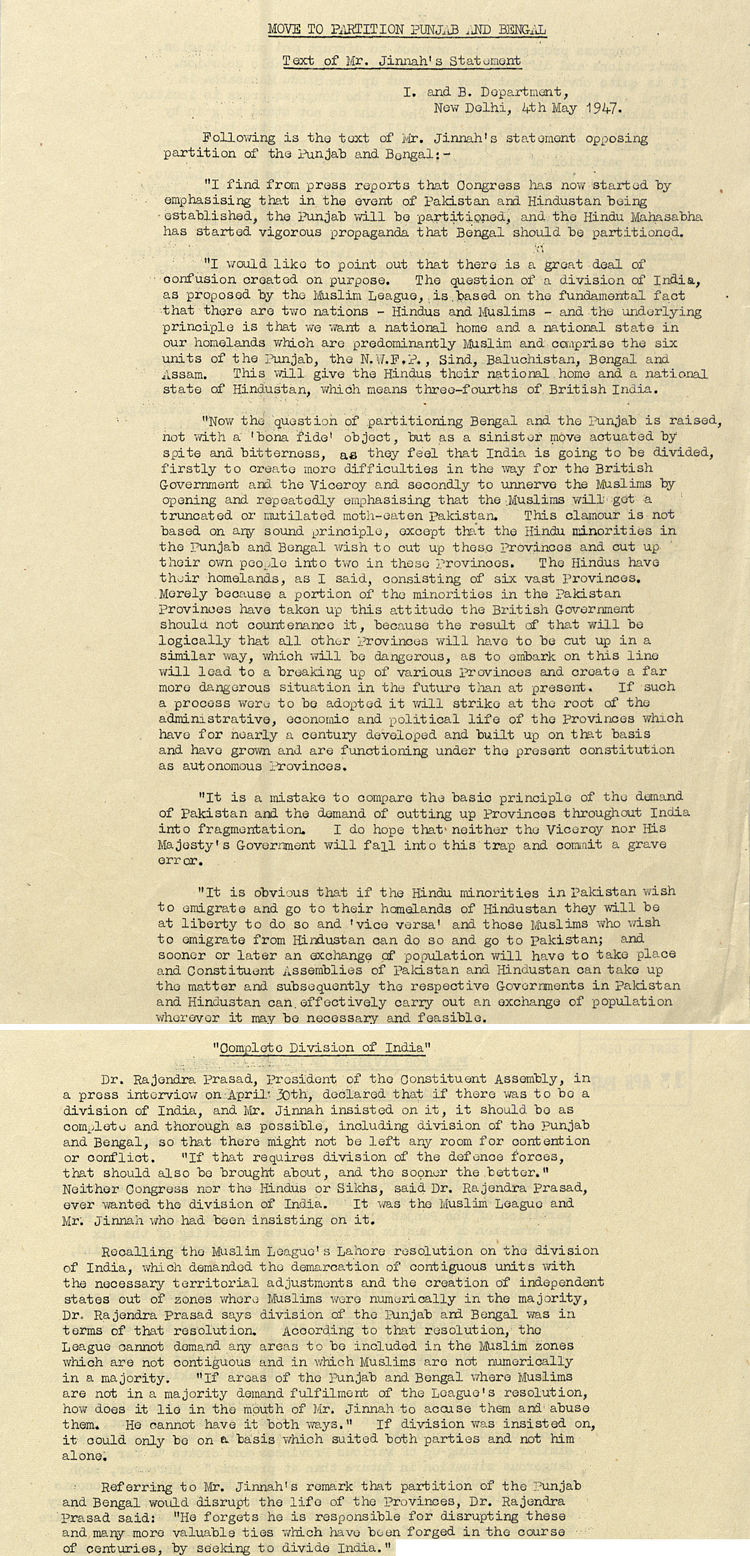
Indeed on his deathbed Mr. Jinnah admitted that he had committed a great blunder by creating a "mutilated, moth-eaten" Pakistan.
Drona, August 2012. PashtunForums 

For additional reading see the follow-up post: Two Muslim Theory

Wednesday, 15 August 2012

Partition: 1947

This post coincides with the 65th anniversary of 'Independence' - that point in 1947 marking the end of the British Raj and the division of the Indian subcontinent into the Union of India and the Dominion of Pakistan. The entire subject remain complex though over the next couple of posts, I hope to explore a few thoughts and opinions on the matter. In this post I begin by starting with a brief history.


British Colonial administration did not directly rule all of "India". There were several different political arrangements: Provinces were ruled directly and the Princely States had varying legal independent arrangements.The Indian National Congress formed in 1884 by a mixture of Indian (Hindu and Muslim) and English activists led for the initial calls to have more Indian representation within the administration.

By 1906 the All India Muslim League had been formed in Dhaka in reaction to what some elite Muslims viewed as Hindu dominance in Congress. As the appeal of Mohandas Gandhi and the Free India movement increased, a number of different scenarios were proposed. Amongst the first to make the demand for a separate state was the philosopher Allama Iqbal, who, in his presidential address to the 1930 convention of the Muslim League, proposed a separate nation for Muslims.

The 1946 Cabinet Mission aimed to reach an agreement between Congress and the Muslim League amid growing tension. Nehru, leading Congress was unwilling to accept a decentralised state and Jinnah, leading the Muslim League (made up largely of the 'secular' landed Muslim elite) returned a demand for Pakistan as a bargaining chip. Initially most Muslims opposed partition and there was no pre or post Pakistan 'plan' right up to the announcement in June 1947 that the British had set a date for handover.

Religious communalism fuelled the British decision to exit early (Lord Louis Mountbatten having just been made Viceroy of India in February 1947) and sealed - by accident - the decision to partition the subcontinent. Sir Cyril Radcliffe never having visited India before was employed to draw the boundaries between the two states in July 1947 five weeks before the end of British rule. On August 15 1947, India was granted her independence, and Pakistan the day before. Note, this was before Radcliffe Boundary Committee had made the announcement on the boundaries and before either country knew their borders. Significantly, partition led to the biggest sudden movement of people in human history  - with up to 12 to 15 million people uprooted within a short period and the after effects felt for years.

More in my next postings ...

Wednesday, 20 June 2012

Ghazala Javed غزاله جاوید

I saw Ghazala Javed غزاله جاوید in concert a little over a year ago and she held the stage with a real presence - combining talent, beauty and grace. The news, therefore, of her death stuns me all the more.

Ghazala's death has generated world-wide media interest and various sources have reported the events of her death (alongside her father) as a domestic 'honour' killing, rather than an act traced to the Taliban in Pakistan's restive north. Ghazala's popularity stemmed Pakistan, Afghanistan, the UAE and across the Pashtoon diaspora. Coming at a young age, her death puts her alongside the many media icons whom I have periodically honoured for being forever known for their youth, beauty and voice.

Inalillahi wa ina illahi rajioun. Of course, the many unnamed people across the world who are killed and injured daily in various acts of violence are not forgotten and I hold a thought for each and all. From Allah we came and to Allah we return. May she rest in peace.

تور خان

Thursday, 1 March 2012

Memories From My Archive

Without much fanfare, I thought I'd share some selected pictures that I took during my trips through Afghanistan and Pakistan  last year. They come from a slightly larger collection that were sitting on my hard-drive. No people, no commentary. Just a few captures that I thought that were blog worthy.


Taken using my Olympus SP800UZ.

Friday, 24 February 2012

Ten Years of Meltdown

Another bomb explosion in Peshawar yesterday claimed yet more lives. Like the explosion in the Khyber tribal district not long back, this happened whilst people waited for a bus. Sadly, this comes less than a week after sectarian violence in Parachinar and today gunmen stormed a police station, again in Peshawar, leading to yet more killing. I can't help but think that right now, it doesn't really matter any more what the faith denomination, ethnic background or political slant of an individual is, in Pakistan - something is seriously malfunctioning. Whilst ultimately violence is indiscriminate; Peshawar, Khyber, Swat, Parachinar, Waziristan, Bajaur and much more, is Pashtoon land and when we turn our violence upon each other, I feel hurt and confusion. At times it feels that we are going down like flies. And I continue to ask why.

Ahmed Rashid, writing for the BBC describes the past ten years perfectly when he says that Pakistan is in Meltdown.  He writes that ten years after becoming embroiled in the US "War on Terror", Pakistan, mired in scandal, may have to face some kind of unilateral US action. This has long been conjecture, but let's face it, when the US enters Pakistani airspace with its drones, this results in civilians being killed. The Raymond Davis shoot-out saw Pakistan bowing to US pressure - thus effectively creating an immunity for American intelligence to kill on Pakistani soil, seemingly without impunity and of course, most infamously Osama bin Laden was hunted down and killed in Abbotabad, whilst Pakistan was asleep. All of these represent US action against Pakistan, whether anyone cares to admit it or not.

But of Pakistan itself - why is it headed towards meltdown? I have a theory. Rather simplistically much of Pakistan's past, present and future woes stem from its schizophrenic relationship with India and how this is dealt with. And yes, there is mass poverty, economic ruin, natural disasters, ethnic unrest and wide-scale political corruption at home. Everything in Pakistan is negatively over politicised - the intelligence services, militant groups, the judiciary, redrawing of provincial boundaries, college campuses, religion, the media, municipality services, the ordinary man on the street and of course, the military. 

Notice there that even whilst discussing this, I didn't even get to politicians. They of course, knowingly sit there in Pakistan temporarily or in exile to escape criminal or corruption charges, watching as everything melts before them.

 
 Cartoon by Satish Acharya

Sunday, 15 January 2012

Payam-e-Mashreq: Message from the East

For a while now, I have been dipping into Allama Iqbal's poetry. A graduate of Cambridge University, Sir Muhammed Iqbal (1837 - 1938, British India), was popularly known as Allama Iqbal (the learned Iqbal) and remains a famed poet, philosopher, lawyer and political activist whose works in Urdu and Farsi have left a profound influence in the subcontinent and beyond.

In Pakistan he is considered a Muslim revivalist and in Afghanistan and Iran, he carries the honorific title or Eghbal-e-Lahori - Iqbal of Lahore. 

Amongst his famed works is the Payam-e-Mashreq (Message from the East) from which this quatrain, is taken.

دل من روشن از سوز درون است

جهان بین چشم من از اشک خون است

از رمز زندگی بیگانه تر باد

کسی کو عشق را گوید جنون است

Dil man roshan az soz darun ast
Jahan bin chasham man as ashk khoon ast
Az ramz zindagee beegana tar bad
Kisee ko ashiq ra goweed janoon ast

My heart is alight with the burning within
I see the world though blood-stained tears
The search for life mysteries alienates us further from breath
For some love is said to be madness

Sunday, 11 September 2011

Never Ending Story

11.9.11

Do I dare put on the television, switch on my computer or pick up a newspaper on a day like this? I, like millions across the globe, have expressed sadness and regret for what happened on this date 10 years ago and how the death and destruction associated with this date continue to haunt us.

The constant media reminders turn the 9/11 attacks into a tragic story of division and misery seemingly without end and this is the thing that troubles me the most. Any credible observer would come to the conclusion that Afghanistan and Pakistan have been brought to their knees by the war on terror and the Pashtoons have suffered the 'most' from the aftermath. 

This isn't about forgetting, but letting go. Last year I wrote: 
I hope that in letting go, we reach an understanding that all is not what it appears. I hope that the innocent are not punished for that that they didn't do. I hope that those with power understand that we must ensure the safety of each other ...

... And I hope that one day when we are free, we fully understand that collectively we are the custodians of the Earth and that collectively our freedom, prosperity and peace are mutual.
Dedicated to Ahmed Omed Khpulwak, BBC Pashto Journalist, killed by a US solider who 'mistook' him for a suicide bomber, July 2011.

 احمد اميد خپلواک

Thursday, 8 September 2011

International Literacy Day

Bangladesh, Brazil, China, Egypt, India, Indonesia, Mexico, Nigeria and Pakistan are the nine most highly-populated countries. They represent more than 60 per cent of the world’s population, over two-thirds of the world’s illiterate adults and over half of the world’s out-of-school children. 

Find out more by following the UNESCO International Literacy Day link and the Twitter Feed for Room to Read.
Related Posts Plugin for WordPress, Blogger...