Showing posts with label History. Show all posts

Thursday, 16 August 2012

The Road to Pakistan

Partition: I include this reflection on partition and the emergence of Pakistan. It draws on the points that were made in the previous posting. Importantly it argues that the reasons for Pakistan were less to do with religion itself, but the preservation of the privileges of a narrow band of landed aristocrats.
Before the 1940s, the membership of Muslim League was solely comprised of non-practicing Muslim landed aristocracy. They had enjoyed fruits of British colonialism, who had bestowed upon them fiefdoms on which they had lorded over. They never wanted Independence from British, whom they considered taller, fairer and worthier rulers. Indeed, Muslim League consistently opposed India's independence, never took part in any agitation, or launched any significant mass movement. They were very comfortable with the status-quo.

The arrival of Mohandas Karamchand Gandhi changed everything. He transformed the independence movement from a debating society to a mass mobilization. He injected his own brand of socialism into the movement. This scared the the Muslim as well as Hindu zamindars. They knew that if British left, their titles will be abolished and land distributed amongst the poor farmers on whom they had preyed upon in the past. The Hindu feudals were complete marginalized by the Congress. However, the non-practicing Muslim feudals launched the movement for Pakistan.


Aside from the landed aristocracy, until 1940s, the majority of Indian Muslims as well as Muslim scholars opposed the creation of Pakistan. . They opposed Pakistan Movement not because they supported secularism. On the contrary, they opposed it because they genuinely believed that the Pakistan's creation would hurt their long-term objective of spreading Islam in India through Da'wah. Even Maulana Maududi objected to Pakistan. Nevertheless, after the Pakistan movement gained momentum, the majority of Muslims voted for the Muslim League led by Mohammad Ali Jinnah whose slogan was 'Pakistan ka matlab kya. La ilaha illallah' over the Congress Party which was under the leadership of Pandit Jawaharlal Nehru and Mahatma Gandhi.

Pakistan's creation was thus an accident of history. As I explained above, the Muslim aristocracy was afraid of losing their undeserved wealth, so they demanded disproportional representation for Muslims, in the legislative assemblies to preserve their privileges, anticipating that the illiterate, poor Muslim masses would be easily manipulated by the use of religious rhetoric. Thus, Pakistan Movement was meant as a bargaining chip, they had no intention of going through with it. There was no actual partition or post-partition plan. Indian National Congress called Muslim League's bluff. Jinnah called for Direct Action Day in August 1946 as a show of strength of Muslims. Wide-spread communal riots first in Bengal then in other parts of India followed. From that day onwards, because of the hatred that ensued, Pakistan was fait accompali. The partition was ensured whether Muslim League leaders wanted it or not. 

This lack of planning is the reason why Pakistan has stumbled from one political crisis to another since its inception, and it took almost 10 years to frame Pakistani constitution (which would later be mutilated multiple times). And, unlike India, no land redistribution took place in Pakistan. The secular non-practicing Muslim aristocrats have new fiefdoms to lord over in Pakistan.

Indeed on his deathbed Mr. Jinnah admitted that he had committed a great blunder by creating a "mutilated, moth-eaten" Pakistan.
Drona, August 2012. PashtunForums 

For additional reading see the follow-up post: Two Muslim Theory

Wednesday, 15 August 2012

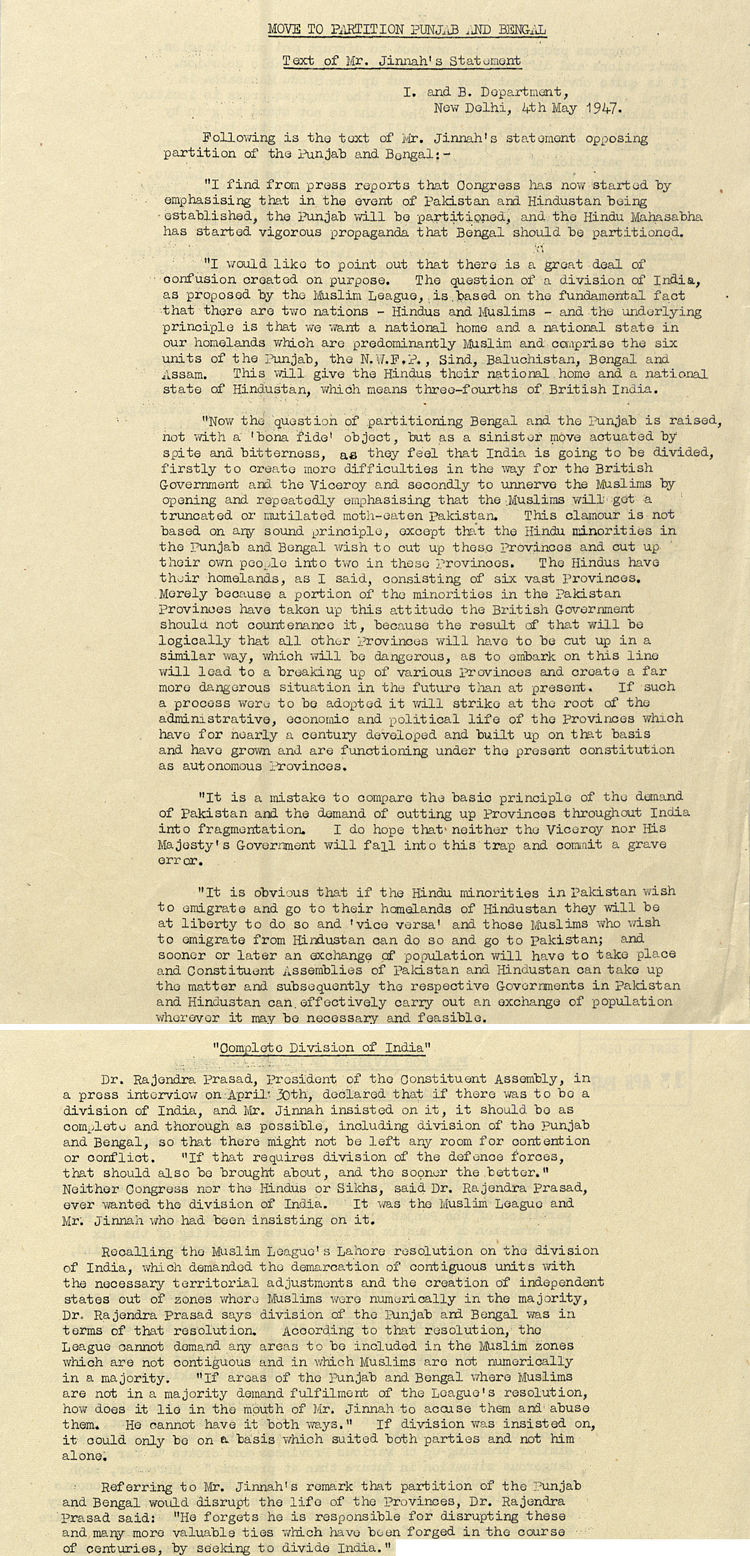
Partition: 1947

This post coincides with the 65th anniversary of 'Independence' - that point in 1947 marking the end of the British Raj and the division of the Indian subcontinent into the Union of India and the Dominion of Pakistan. The entire subject remain complex though over the next couple of posts, I hope to explore a few thoughts and opinions on the matter. In this post I begin by starting with a brief history.


British Colonial administration did not directly rule all of "India". There were several different political arrangements: Provinces were ruled directly and the Princely States had varying legal independent arrangements.The Indian National Congress formed in 1884 by a mixture of Indian (Hindu and Muslim) and English activists led for the initial calls to have more Indian representation within the administration.

By 1906 the All India Muslim League had been formed in Dhaka in reaction to what some elite Muslims viewed as Hindu dominance in Congress. As the appeal of Mohandas Gandhi and the Free India movement increased, a number of different scenarios were proposed. Amongst the first to make the demand for a separate state was the philosopher Allama Iqbal, who, in his presidential address to the 1930 convention of the Muslim League, proposed a separate nation for Muslims.

The 1946 Cabinet Mission aimed to reach an agreement between Congress and the Muslim League amid growing tension. Nehru, leading Congress was unwilling to accept a decentralised state and Jinnah, leading the Muslim League (made up largely of the 'secular' landed Muslim elite) returned a demand for Pakistan as a bargaining chip. Initially most Muslims opposed partition and there was no pre or post Pakistan 'plan' right up to the announcement in June 1947 that the British had set a date for handover.

Religious communalism fuelled the British decision to exit early (Lord Louis Mountbatten having just been made Viceroy of India in February 1947) and sealed - by accident - the decision to partition the subcontinent. Sir Cyril Radcliffe never having visited India before was employed to draw the boundaries between the two states in July 1947 five weeks before the end of British rule. On August 15 1947, India was granted her independence, and Pakistan the day before. Note, this was before Radcliffe Boundary Committee had made the announcement on the boundaries and before either country knew their borders. Significantly, partition led to the biggest sudden movement of people in human history  - with up to 12 to 15 million people uprooted within a short period and the after effects felt for years.

More in my next postings ...

Friday, 10 February 2012

The Story of Swat (1862-1969) Part 4

Part four of the series on the history of Swat. In this part we are introduced to the non-Muslim minorities who have made Swat their home.


Tor_Khan تور خان

Saturday, 4 February 2012

Tuesday, 15 February 2011

Mirwais Hotak - ميرويس هوتک

Mirwais Khan Hotak, (1673–1715) Ghilzai Pashtoon, founder of the  Hotak Dynasty and Emir of Greater Kandahar* is widely celebrated amongst the Pashtoons for ending the repressive rule of Gorgin Khan, (King George of Kartli, Georgia) when the latter was posted to Kandahar as Viceroy (Beglarbeg) by the Safavid ruler, Soltan Hussein. 

Mirwais Hotak, was at first taken prisoner by Gorgin Khan and sent  to Isfahan, but then was later granted the right to perform Hajj by the Shah. He returned to Kandahar to challenge the Gorgin where he raised a rebellion and took this to into Persia, ending the 200 year rule of the Safavids and establishing Afghan rule over Isfahan. 

MIrwais refused the title of King, despite his liberation of Afghan lands and his conquest of Persia, but instead accepted the tile of Mashar (elder). To the Pashtoons, Haji Mirwais Hotak remains Mirwais Neeka حاجي ميرويس نيکه (Grandfather Mirwais) a unifier of the Pashtoon people and a national hero. 

Tor_Khan تور خان
  
*today this would be much of southern Afghanistan and Sistan-Balochistan

For a short film on Afghan History, click here.

Monday, 14 February 2011

A Conversation Between Two Great Men

When I reflect on the continuing turmoil that surrounds the lands of my people, I think of how far we have strayed from Bacha Khan's vision. I take comfort, however, in these words here - the possibility - the hope and the belief of who we are. Here's an excerpt of a conversation between Mahatma Gandhi and Bacha Khan, two incredibly great men:

BACHA KHAN: Gandhiji, you have been preaching non violence in India for a long time now, but I started teaching the Pathans non-violence only a short time ago. Yet, in comparison, the Pathans seem to have grasped the idea of non-violence much quicker and much better than the Indians. Just think how much violence there was in India during the war in 1942. Yet in the North West Province, in spite of all the cruelty and the oppression the British inflicted upon them, not one Pathan resorted to violence, though they too possess the instruments of violence. How do you explain that?

GANDHIJI: Non-violence is not for cowards. It is for the brave and the courageous. And the Pathans are more brave and courageous than the Hindus. That is the reason why the Pathans were able to remain non-violent.

Read more.

Saturday, 12 February 2011

Fall of the Pharaoh: Umm Al Dunya

Umm Al Dunya


And so the Pharoah in Egypt falls after a 30 year grip on power. I may be forgiven for referring to Hosni Mubarak as a Pharoah, but see a Pharoah, was NOT just a despotic Emperor King who was considered a deity. The word Pharoah referred to a Great House. Does the Great House still hold power? When a House falls, crushed by the weight of its age and ruin, another one can be built in its place. But in Egypt do we see a  rebuilding or another Pharaoh King moving into the Great House? Right now the military has moved in so not much changes; later, perhaps, the old house can be demolished and a new one built by the will of the people.

The Egyptians call their country Umm Al Dunya - Mother of the World.  An ancient cradle of civilisation, social order, technology and writing. There will be many who in years to come will look back at how in 2011 the Egyptian Pharaoh of Old was brought down by a technology and social media of new - Twitter/Blogger/Facebook and the like. Now here's where I do get to see close up what is happening - I know people and have spoken with them, both in person and through electronic communications that this Egyptian revolution is an e-revolution of a kind.

I wonder about the transferability of the UAE model - it's a "minus democracy" model that isn't perfect, but evidently people coming in see prosperity, internationalism, relative freedom and hope. In many ways this is what the Egyptian and Tunisian revolutions were about right? Hope itself? That, I pray, is the message that the people in our Arab neighbourhood carry in the months and years to come.

Saturday, 11 September 2010

IX.XI

Remembrance And Hope

Nine years ago, this date - 9/11 - became immortalised in our common knowledge and the lexis of probably most the languages on the Earth.

I love the American spirit.

I always have. Feisty, independent, accommodating and where people can live the dream. Nine years ago, The United States of America was hurt. There, I've said it.


I love the Afghan spirit.

I love the land of Afghanistan because the history is in my blood. The land that is and was Afghanistan gave rise to the Pashtoon people, my present and past. I love the Pashtoon way, no-nonsense, independent, accommodating, and a people who dream of so much more than they have. Nine years ago, the events in the US meant that the Americans invaded Afghanistan. The country is still hurting. For so many, the wounds are open, exposed and infected.


For that dynamic alone, we should remember 9/11.

For now, that is.


But one day, I hope we can free ourselves from this past. One day, I hope, that we learn to understand that ordinary Afghans had nothing to do with the events in New York and Washington. I hope that people are allowed to mourn their losses in private without a date being used to divide us into polar opposites.

I hope that in letting go, we reach an understanding that all is not what it appears. I hope that the innocent are not punished for that that they didn't do. I hope that those with power understand that we must ensure the safety of each other, but allow people to find their own way. I hope that people are not so poor that they are vulnerable to being manipulated for the selfish motives of others.

And I hope that one day when we are free, we fully understand that collectively we are the custodians of the Earth and that collectively our freedom, prosperity and peace are mutual.

Tor_Khan تور خان

Note: The title for this entry is IX.XI. I have used the Roman Numerals to indicate today's date. Whilst I'm sure that others have discovered this before me, note that in Roman Numeral form, the date is of course a Palindrome and is read the same reading from the left or the right.

Friday, 18 September 2009

History and Folklore


Sir Olaf Caroe's 1957 narrative on the Pashtoons digs into the historic and folkloric orgins of the Pashtoon people. It is sometimes held as the compendium of Pashtoon history and origin. The book, known as "The Pathans", reflects the language of its time and whilst other major events have occurred in the Pashtoon lands since the book was written, the contempt/admiration of the Pashtoons is something that continues till today.

Technology allows us to read these archives online - click on the picture above for the online reading option. Alternatively, download your PDF copy of the book here.
Tor_Khan تور خان

Saturday, 30 May 2009

خوشحال خان خټک : د افغان ننګ

Khushal Khan Khattak: Afghan Pride


During these troubled times for the Pashtoons, I shall take a little look back in history to honour Khushal Khan Khattak, (
خوشحال خان خټک) celebrated warrior and poet.

The Pashtoon heartlands have been at the helm of successive waves of aggression, both internal and external and this has led to localised resistance and an almost continual state of chaos. Recent history bears this out - 19th century policies of the British in India led to three wars with Afghanistan as part of "The Great Game" strategy centred around Russian and the British rivalry for control over Central Asia. The resistance - which Pashtoons are famed for - has been demonstrated time and again - during the Sikh excursions into Afghan territory, the Russian Occupation and the recent American-led invasion.

Earlier, during 17th Century Mughal rule, Khushal Khan Khattak (born near Nowshera, 1613 into a celebrated family) took up a revolt against the Mughal Emperor, Aurangzeb. Khushal Khan's father, Shahbaz Khan and grandfather, Malik Akoray had held service under the Emperor Shah Jahan, but by the time that Aurangzeb has ascended the throne, the relationships had soured and Khushal Khan was imprisoned in Gwalior Fortress, South of Agra.

Warrior Poet: The Pen And The Sword

As well as leading the resistance upon his rele
ase, Khushal Khan worked to unite the Pashtoon tribes. Over the years, he wrote considerablly and built up a formidable anthology of poems on war, honour and love. He died in 1689 and asked to be buried on the frontiers of the Mughal Empire. The epitaph on his Mazar in Nowshera, modern Pakistan reads:

د افغان په ننګ مې وتړله توره
ننګيالی د زمانې خوشحال خټک يم

I have taken up the sword to defend the pride of the Afghan,
I am Khushal Khattak, the honourable man of this age.


Tor_Khan تور خان

Monday, 13 April 2009

Attan 3 - More History

A Look Into Afghan History Through Attan (Part 2)

Final in the series on Attan and second part of the film on Afghan history.


Tor_Khan تور خان

Sunday, 12 April 2009

Attan 2 - A Journey Through History

A Look Into Afghan History Through Attan (Part 1)

I stumbled upon this documentary that takes us on a tour of Afghan history through the images and sounds of the Afghan National Dance, the Attan. Quite a clever idea as you can learn the history whilst enjoying the Attan.


Tor_Khan تور خان

Friday, 6 March 2009

The Diwan of Rahman Baba (رحمان بابا)

Rahman Baba, (رحمان بابا, Grandfather Rahman) is also called the Nightingale of Pakhtoonkhwa
I joined the interest group in Facebook some some months ago and I had been planning a piece of writing on Rahman Baba for this blog before the recent attack on his mazar.

Seems like along with the many other troubles in Pakistan and Afghanistan including the violence in the Pashtoon belt, bizarre deals with the Taleban, death and destruction has become so commonplace, there's a danger that we carry on without realising the long term impact. The recent dismantling of girls' education in Swat, and mass exodus of people from Bajuar, Swat and the neighbouring areas can somehow be seen as part of a sustained campaign all serving to hit the historical culture of the Pashtoon people.

The Diwan of Rahman Baba

Born over 300 years ago in the Afghan mountains, Abdul Rahman was destined to become one of the most loved and well known poets in Pashto literature. A studious child, Abdul Rahman grew to be a man of great character. Rahman lived a life of solitude, prayer and devotion to Islam.

Traditional Afghan poetry is essentially an oral art without the need of pen and ink, and only later are they collected into books. Rahman Baba's collection are available in a collection, entitled The Diwan of Rahman Baba.
Tor_Khan تور خان

Sow Flowers

Sow flowers so your surroundings become a garden,
Don’t sow thorns; for they will prick your feet

If you shoot arrows at others,
Know that the same arrow will come back to hit you.

Don’t dig a well in another’s path,
In case you come to the well’s edge

You look at everyone with hungry eyes
But you will be first to become mere dirt.

Humans are all one body,
Whoever tortures another, wounds himself.

Rahman Baba (رحمان بابا)
Related Posts Plugin for WordPress, Blogger...