Showing posts with label Partition of India. Show all posts

Friday, 16 August 2013

Two-Muslim Theory: Part 2

... continued from previous posting ...

Changing the Narrative

Nawabzada Liaqat Ali Khan was was born in 1895 to a Muslim aristocrat family whose jagir started at the eastern edge of Punjab (now Haryana) and stretched into Uttar Pradesh. His family had cordial relations with the British. His grandfather extended support to the British during the hard times of 1857 and his father earned many titles and honours.

Liaqat Ali went to Aligarh and then to Oxford. On his return from London in 1923, he joined Muslim League. He contested his first elections in 1926 on a seat reserved for Muslims in the UP Assembly (Muzaffarnagar constituency) and comfortably won. He grew into an eloquent parliamentarian, pleading mostly for the causes of Muslim landlords who were a minority in that province.

He became one of the most important members of the Muslim League's vanguard. Nawabzada is, in fact, credited to have convinced a dejected and disappointed Muhammad Ali Jinnah to end his 'self-imposed exile' in London and lead the movement for a separate homeland for Muslims. Liaqat Ali Khan was made the General Secretary of the Muslim League in 1936.

The party's parliamentary committee did not award him the ticket for the 1936 elections for his home constituency which he valued highly. Despite holding a high office in the Muslim League, he contested as an independent from his home constituency and faced criticism of fellow party men.

He contested the 1946 elections for the Central Legislative Assembly on the Muslim seat of Meerut in Uttar Pradesh. Following this victory, Liaqat Ali won a place in the Constituent Assembly of Pakistan and at independence was made the first Prime Minister with the additional charge of Foreign Affairs and Commonwealth Relations and Defense. He remained the longest serving prime minister until Yousuf Raza Gilani exceeded him by a few weeks recently.

Prime Minister Liaqat Ali is accredited with a number of ground breaking contributions. He decided to ally with the US in the Cold War divide; quashed a coup attempt by communists; promoted General Ayub to the highest rank and fought a war with India over Kashmir to name just a select few. His government ruled on ad hoc basis under temporary laws as it could not formulate and build a consensus on a constitution for the country.

Reasons were simple. They could not dig out a monarchy to rule the country nor could they install a Caliph. The constitution had to be based on democracy. But the problem was that Meerut was now in India. The most powerful Prime Minister serving for one of the longest periods in the history of Pakistan had no constituency in the country to contest elections from. A committed democrat and an active parliamentarian, he  knew well that he and his political class had no, or at best a very shaky, future under a democracy. In contrast, Bacha Khan's was a completely secure political position. It was impossible to democratically uproot him from his constituency. He had voters, volunteers and diehard loyalists.

The ad hoc powers were thus used to change the rules of the game. Six months after the death of Muhammad Ali Jinnah, Prime Minister Liaqat Ali Khan moved the Objective Resolution in the Constituent Assembly that introduced Islam as the raison d'être of the new country. Religion was pitched against linguistic and cultural identity and faith was made to rival political interests. Those loving their culture, defending their language and demanding their democratic and political rights on these grounds became heretics conspiring against the last citadel of Islam in the Subcontinent. Ideological boundaries of the country became more important than the limits of electoral constituencies and principles of democracy were contrasted to injunctions of Islam as defined by a selected ulema.

Bacha Khan who enjoyed a hard earned and unflinching popular support in a vast constituency went down in official gazettes as an anti-Pakistan traitor. Red Shirts were hounded and hunted. Politicians were jailed and elections were rigged.

By declaring the entire country as one constituency and setting ones perceived Islamic credentials as the only qualification, Liaqat Ali Khan tried to create a constituency for his class – the politically insecure Muslim elite that had migrated from the Muslim minority provinces of India. But ironically, they could not sustain their hold on this constituency for long. Within a decade they were outdone by the Army in the game they had pioneered. They were declared incapable of defending the citadel of Islam. The army took over the 'responsibility' of keeping the country united in the name of Islam and secure from the conspirators who had strong democratic constituencies in the country.

The army did not feel the need to redraft the national narrative that was scripted in those initial years. It was found to be in perfect harmony with the Army's own scheme to block or cripple democracy and sustain its direct or indirect rule for decades to come. The narrative persists with all its detail and corollaries and insists on its refusal to recognise Bacha Khan as a great national hero.

Wednesday, 14 August 2013

Two-Muslim Theory: Part 1

Article originally by Tahir Mehdi appeared in the Dawn. Presented here in an adapted format. 

Introducing Bacha Khan

When someone says 'Muslims of Indo-Pak subcontinent' with reference to history, does this refer to one unanimous, monolithic block of people with no shades and diversity? The reality is divergent political interests and ambitions of Muslims throughout the subcontinents history before and beyond the period that ended on this day 65 years ago. A reintroduction to these groups and how the new state of Pakistan responded to their political aspirations might help us understand where we stand now.

Pre-partition Muslims can be classified in many ways beyond sectarian differences within Islam. The followers of one sect are not a completely homologous group either, as they may differ on other counts like economic class, cast, language, culture etc. These attributes have an impact on way people behave and act in spheres of economy, politics, culture and even faith. It's only natural to consider that all these factors make one what he or she is. Instead of labouring over an academically-sound definition of each, this post offers an example of one person from two of these two groups.

Abdul Ghaffar Khan was born in 1890 to rural middle-class Pakhtun parents of Utmanzai, a small town in the present day district of Charssadda. At the age of 20 he opened a school in his village. He had woken up to the fact that his people have no future if they don't educate themselves and their children. The tall, young man proved to be a zealous missionary. He would walk for miles from one village to the other with his simple message – educate yourself and abstain from violence. He was a devout Muslim, a five-timer namazi parhaizgar and would draw heavily from Islamic history and the Prophet's sayings to rally fellow Pakhtuns. People joined him in droves. 

His appeal matured into charisma and in his 30s, he founded a social reform movement named Khudai Khidmatgar (Servants of God). By now he was named Badshah Khan or Bacha Khan. The movemen gave its volunteers a uniform that was red and organised them on the pattern of a militia that was, in his words, armed "with the weapon of the Prophet – that is, patience and righteousness. No power on earth can stand against it." It was only Bacha Khan who could unarm Pakhtuns who otherwise were considered quarrelsome and trigger-happy.

The Red Shirts, as the volunteers of the movement were known as, were against the British rule and demanded self government. For the British, the then province of NWFP had great strategic importance. It was a so-called buffer against the Afghan government that was not friendly with the Raj and also against the Russians whom the British dreaded as their rivals.

The Bolshevik revolution of Russia in 1917 was emerging as a huge challenge for Imperialism. It had a natural affinity with the nations oppressed by the British. The Russian revolution was colored red. The sight of a Red Shirt in the Peshawar valley gave the British a fright. At Qisa Khani Bazar in 1930, the frenzied British forces fired directly at a protest rally of unarmed Khudai Khidmatgars killing many hundreds. The movement and its committed cadre did not budge. They stood fast. Many estimate that at its peak there were as many as a hundred thousand Red Shirts.

When the British adopted a cautious policy of sharing power with local political forces and initiated limited franchise elections, the group allied with Indian National Congress. It contested successive elections, won majority and formed governments in the province. As the British hated them, they would conspire against the Red Shirts and jailed Bacha Khan frequently and for long periods but could not undo the politicisation of the Pakhtun middle class that he had initiated.

Pakhtun felt comfortable with Congress and that didn't bear out of some personal friendship between the top leaders. Congress accommodated politics of budding smaller sub-national groups, offered them space for growth and opportunity to integrate with others without giving much consideration to religion. On the other hand, Bacha Khan did not owe his 'fearlessness' vis a vis Hindus to Pakhtun chivalric traditions, instead he had earned this confidence through successive electoral victories. He had a large constituency where Muslims were in majority. There were Hindus too but Pakhtuns did not see Hindus as threat to their religion or politics.

Despite its vociferous campaign Muslim League could not ignite fears of Hindu domination in the support base of Bacha Khan. His comrades won the land mark elections of 1946 with a thumping majority. He opposed the Partition on the basis of religion, but it happened. His democratically elected government was dismissed 8 days after the independence, on 22 August, 1947 when Muhammad Ali Jinnah was the Governor General and Liaqat Ali Khan was the Prime Minister.

read more in the next posting

Friday, 17 August 2012

Two-Nation Theory I

This write up is taken from an article in the Dawn newspaper by Tehir Mehdi. It challenges the Two-Nation Theory that is cited as the raison d'être of Pakistan. Interestingly it makes the point that despite Bacha Khan remaining a pious Muslim he did not harbour the antagonisms that fuelled partition. For this reason and the cultural closeness to Afghanistan, the Khudai Khidmatgars were viewed as having not accepted the Two Nation theory. Bacha Khan and Pashtoons of the Khudai Khidmatgars were systematically jailed under charges of treason and their contributions to the Free India movement were written out of the texts of Pakistan history.
When someone says ‘Muslims of Indo-Pak subcontinent’ with reference to our history, does this refer to one unanimous, monolithic block of people with no shades and diversity? I think it’s a big folly to ignore how divergent the political interests and ambitions of Muslims were in the period that ended on this day 65 years ago. A reintroduction to these groups and how the new state of Pakistan responded to their political aspirations might help us understand where we stand now.

Pre-partition Muslims can be classified in many ways. For now I would put them into two larger groups and instead of laboring over an academically-sound definition of each, I will demonstrate my point by offering example of one person from each of these two groups.

Abdul Ghaffar Khan was born in 1890 to rural middle-class Pakhtun parents of Utmanzai, a small town in the present day district of Charssadda. At the age of 20 he opened a school in his village. He had woken up to the fact that his people have no future if they don’t educate themselves and their children. The tall, young man proved to be a zealous missionary. He would walk for miles from one village to the other with his simple message – educate yourself and abstain from violence. He was a devout Muslim, a five-timer namazi parhaizgar and would draw heavily from Islamic history and the Prophet’s sayings to rally fellow Pakhtuns. People joined him in droves. His arcane appeal matured into charisma, some would even give him a halo.

In his 30s, he founded a social reform movement named Khudai Khidmatgar (Servants of God). By now he was named Badshah Khan or Bacha Khan. The movement, like many others of that era, gave its volunteers a uniform that was red and organised them on the pattern of a militia that was, in his words, armed “with the weapon of the Prophet – that is, patience and righteousness. No power on earth can stand against it.” It was only Bacha Khan who could unarm Pakhtuns who otherwise were considered quarrelsome and trigger-happy.

The Red Shirts, as the volunteers of the movement were known as, were against the British rule and demanded self government. For the British, the then province of NWFP had great strategic importance. It was a so-called buffer against the Afghan government that was not friendly with the Raj and also against the Russians whom the British dreaded as their rivals.

The Bolshevik revolution of Russia in 1917 was emerging as a huge challenge for Imperialism. It had a natural affinity with the nations oppressed by the British. The Russian revolution was colored red. The sight of a Red Shirt in the Peshawar valley gave the British a fright. At Qisa Khani Bazar in 1930, the frenzied British forces fired directly at a protest rally of unarmed Khudai Khidmatgars killing many hundreds. The movement and its committed cadre did not budge. They stood fast. Many estimate that at its peak there were as many as a hundred thousand Red Shirts.

When the British adopted a cautious policy of sharing power with local political forces and initiated limited franchise elections, the group allied with Indian National Congress. It contested successive elections, won majority and formed governments in the province. As the British hated them, they would conspire against the Red Shirts and jailed Bacha Khan frequently and for long periods but could not undo the politicisation of the Pakhtun middle class that he had initiated.

Pakhtun Muslims felt comfortable with Congress and that didn’t bear out of some personal friendship between the top leaders. Congress accommodated politics of budding smaller sub-national groups, offered them space for growth and opportunity to integrate with others without giving much consideration to religion. On the other hand, Bacha Khan did not owe his ‘fearlessness’ vis a vis Hindus to Pakhtun chivalric traditions, instead he had earned this confidence through successive electoral victories. He had a large constituency where Muslims were in majority. There were Hindus too but Pakhtun Muslims did not see Pakhtun Hindus as threat to their religion or politics.
... continued in the next post ...

Thursday, 16 August 2012

The Road to Pakistan

Partition: I include this reflection on partition and the emergence of Pakistan. It draws on the points that were made in the previous posting. Importantly it argues that the reasons for Pakistan were less to do with religion itself, but the preservation of the privileges of a narrow band of landed aristocrats.
Before the 1940s, the membership of Muslim League was solely comprised of non-practicing Muslim landed aristocracy. They had enjoyed fruits of British colonialism, who had bestowed upon them fiefdoms on which they had lorded over. They never wanted Independence from British, whom they considered taller, fairer and worthier rulers. Indeed, Muslim League consistently opposed India's independence, never took part in any agitation, or launched any significant mass movement. They were very comfortable with the status-quo.

The arrival of Mohandas Karamchand Gandhi changed everything. He transformed the independence movement from a debating society to a mass mobilization. He injected his own brand of socialism into the movement. This scared the the Muslim as well as Hindu zamindars. They knew that if British left, their titles will be abolished and land distributed amongst the poor farmers on whom they had preyed upon in the past. The Hindu feudals were complete marginalized by the Congress. However, the non-practicing Muslim feudals launched the movement for Pakistan.


Aside from the landed aristocracy, until 1940s, the majority of Indian Muslims as well as Muslim scholars opposed the creation of Pakistan. . They opposed Pakistan Movement not because they supported secularism. On the contrary, they opposed it because they genuinely believed that the Pakistan's creation would hurt their long-term objective of spreading Islam in India through Da'wah. Even Maulana Maududi objected to Pakistan. Nevertheless, after the Pakistan movement gained momentum, the majority of Muslims voted for the Muslim League led by Mohammad Ali Jinnah whose slogan was 'Pakistan ka matlab kya. La ilaha illallah' over the Congress Party which was under the leadership of Pandit Jawaharlal Nehru and Mahatma Gandhi.

Pakistan's creation was thus an accident of history. As I explained above, the Muslim aristocracy was afraid of losing their undeserved wealth, so they demanded disproportional representation for Muslims, in the legislative assemblies to preserve their privileges, anticipating that the illiterate, poor Muslim masses would be easily manipulated by the use of religious rhetoric. Thus, Pakistan Movement was meant as a bargaining chip, they had no intention of going through with it. There was no actual partition or post-partition plan. Indian National Congress called Muslim League's bluff. Jinnah called for Direct Action Day in August 1946 as a show of strength of Muslims. Wide-spread communal riots first in Bengal then in other parts of India followed. From that day onwards, because of the hatred that ensued, Pakistan was fait accompali. The partition was ensured whether Muslim League leaders wanted it or not. 

This lack of planning is the reason why Pakistan has stumbled from one political crisis to another since its inception, and it took almost 10 years to frame Pakistani constitution (which would later be mutilated multiple times). And, unlike India, no land redistribution took place in Pakistan. The secular non-practicing Muslim aristocrats have new fiefdoms to lord over in Pakistan.

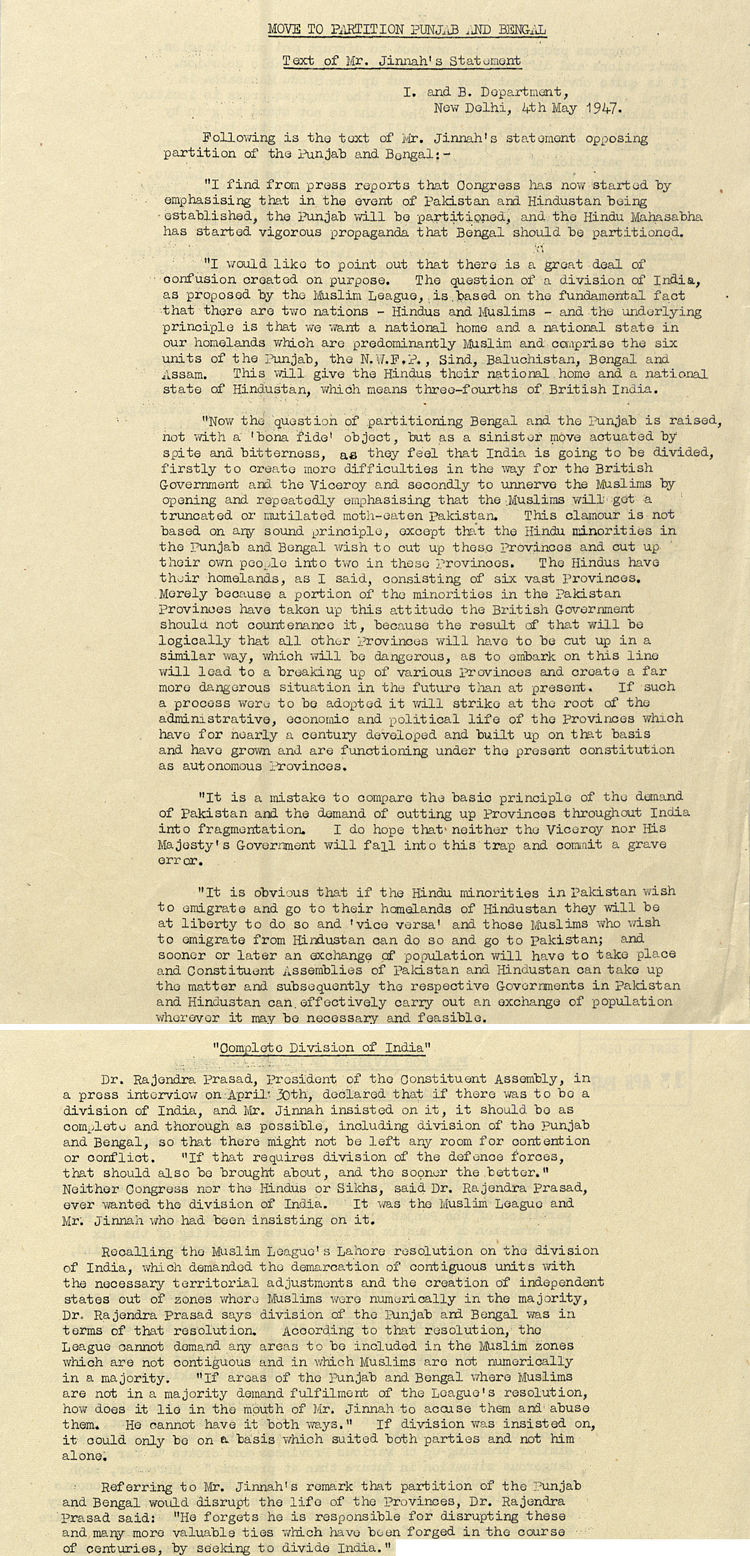
Indeed on his deathbed Mr. Jinnah admitted that he had committed a great blunder by creating a "mutilated, moth-eaten" Pakistan.
Drona, August 2012. PashtunForums 

For additional reading see the follow-up post: Two Muslim Theory

Wednesday, 15 August 2012

Partition: 1947

This post coincides with the 65th anniversary of 'Independence' - that point in 1947 marking the end of the British Raj and the division of the Indian subcontinent into the Union of India and the Dominion of Pakistan. The entire subject remain complex though over the next couple of posts, I hope to explore a few thoughts and opinions on the matter. In this post I begin by starting with a brief history.


British Colonial administration did not directly rule all of "India". There were several different political arrangements: Provinces were ruled directly and the Princely States had varying legal independent arrangements.The Indian National Congress formed in 1884 by a mixture of Indian (Hindu and Muslim) and English activists led for the initial calls to have more Indian representation within the administration.

By 1906 the All India Muslim League had been formed in Dhaka in reaction to what some elite Muslims viewed as Hindu dominance in Congress. As the appeal of Mohandas Gandhi and the Free India movement increased, a number of different scenarios were proposed. Amongst the first to make the demand for a separate state was the philosopher Allama Iqbal, who, in his presidential address to the 1930 convention of the Muslim League, proposed a separate nation for Muslims.

The 1946 Cabinet Mission aimed to reach an agreement between Congress and the Muslim League amid growing tension. Nehru, leading Congress was unwilling to accept a decentralised state and Jinnah, leading the Muslim League (made up largely of the 'secular' landed Muslim elite) returned a demand for Pakistan as a bargaining chip. Initially most Muslims opposed partition and there was no pre or post Pakistan 'plan' right up to the announcement in June 1947 that the British had set a date for handover.

Religious communalism fuelled the British decision to exit early (Lord Louis Mountbatten having just been made Viceroy of India in February 1947) and sealed - by accident - the decision to partition the subcontinent. Sir Cyril Radcliffe never having visited India before was employed to draw the boundaries between the two states in July 1947 five weeks before the end of British rule. On August 15 1947, India was granted her independence, and Pakistan the day before. Note, this was before Radcliffe Boundary Committee had made the announcement on the boundaries and before either country knew their borders. Significantly, partition led to the biggest sudden movement of people in human history  - with up to 12 to 15 million people uprooted within a short period and the after effects felt for years.

More in my next postings ...

Sunday, 28 February 2010

Nuclear Neighbourhood

With a fifth of the world's population between them, deep distrust and the never ending threats and posturing, a question on a BBC forum that caught my interest was, "Should Pakistan and India engage in dialogue?" It's a valid question especially considering that there are many who are deeply apathetic about the situation in South Asia and for varying reasons feel that talking to the neighbour has never quite yielded desirable outcomes. Personally, whatever we think of the political game play, it would be very worrying if Pakistan and India didn't speak. Why is this so? Well it's because they are nuclear powers for one.

Here's a comment left by a contributor called Vejain (at 11:56am on 17 Feb 2010) on Soutik Biswas's blog that he writes for the BBC. The comment is in relation to the stalemate between India and Pakistan:

The US is responsible for creating this morass of mind-boggling proportions. Had it not been for US's insatiable thirst for showing its might to the "commies" it would not have got involved in Vietnam and Afghanistan. After it was ignominiously defeated by the North Vietnamese with China's help, the US tried a different tack. As USSR was perceived a bigger threat to capitalism and as there is no love lost between China and USSR, why not get China on its side? Thus the policy of "engaging" China rather than isolating it. To be bedfellows with China they used Pakistan as the go-between. As a result of this 'engagement' China became the world's factory for manufactured goods - at the cost of decimating industries of the West and almost destroying their economies.

CIA and its progeny ISI did manage to drive the Russians out of Afghanistan, but in the process created the Taliban monster. Now the US is facing two self-inflicted monsters – Chinese hegemony and ISI delinquency. One has destroyed its economy and the other is thwarting its efforts in Afghanistan by inventing the so-called good Taliban and bad Taliban!!

Food for thought, I guess.

Saturday, 30 January 2010

One People

In response to a reader letter to his publication Harijan in 1939, Ghandi wrote this reponse. Readers of this blog will be able to figure the political position posed by the writer of the letter, but here I admire how Gandhi clearly understood the universality of people. His answers take the form of questions and the message - from any perspective - Hindu or Muslim - remains relevant today, over 62 years after Gandhi's death on 30th January 1948.
Why is India not one nation?

Was it not one during, say, the Mughal period? Is India composed of two nations? If it is, why only two? Are not Christians a third, Parsis a fourth, and so on? Are the Muslims of China a nation separate from the other Chinese? Are the Muslims of England a different nation from the other English? How are the Muslims of the Punjab different from the Hindus and the Sikhs? Are they not all Punjabis, drinking the same water, breathing the same air and deriving sustenance from the same soil? ...

... The way suggested by the correspondent is the way of strife. Live and let live or mutual forbearance and toleration is the law of life. That is the lesson I have learnt from the Quran, the Bible, the Zend Avesta and the Gita.

Friday, 22 May 2009

Children of War

The reality to the chaos of war are the children who get displaced when families are forced to leave. It's a tragedy. I have children too. I tell them that they are lucky because we are in a safe place. We are the same, after all. The same as the children of Swat in the pictures here.

The violence in the Malakand Division has led to the biggest movement of people within Pakistan since the Partition of India in 1947.

I was sent this link (see http://www.swatvalleyappeal.org.uk). It's a humaritarian appeal:

Related Posts Plugin for WordPress, Blogger...