Showing posts with label Mahtma Gandhi. Show all posts

Thursday, 16 August 2012

The Road to Pakistan

Partition: I include this reflection on partition and the emergence of Pakistan. It draws on the points that were made in the previous posting. Importantly it argues that the reasons for Pakistan were less to do with religion itself, but the preservation of the privileges of a narrow band of landed aristocrats.
Before the 1940s, the membership of Muslim League was solely comprised of non-practicing Muslim landed aristocracy. They had enjoyed fruits of British colonialism, who had bestowed upon them fiefdoms on which they had lorded over. They never wanted Independence from British, whom they considered taller, fairer and worthier rulers. Indeed, Muslim League consistently opposed India's independence, never took part in any agitation, or launched any significant mass movement. They were very comfortable with the status-quo.

The arrival of Mohandas Karamchand Gandhi changed everything. He transformed the independence movement from a debating society to a mass mobilization. He injected his own brand of socialism into the movement. This scared the the Muslim as well as Hindu zamindars. They knew that if British left, their titles will be abolished and land distributed amongst the poor farmers on whom they had preyed upon in the past. The Hindu feudals were complete marginalized by the Congress. However, the non-practicing Muslim feudals launched the movement for Pakistan.


Aside from the landed aristocracy, until 1940s, the majority of Indian Muslims as well as Muslim scholars opposed the creation of Pakistan. . They opposed Pakistan Movement not because they supported secularism. On the contrary, they opposed it because they genuinely believed that the Pakistan's creation would hurt their long-term objective of spreading Islam in India through Da'wah. Even Maulana Maududi objected to Pakistan. Nevertheless, after the Pakistan movement gained momentum, the majority of Muslims voted for the Muslim League led by Mohammad Ali Jinnah whose slogan was 'Pakistan ka matlab kya. La ilaha illallah' over the Congress Party which was under the leadership of Pandit Jawaharlal Nehru and Mahatma Gandhi.

Pakistan's creation was thus an accident of history. As I explained above, the Muslim aristocracy was afraid of losing their undeserved wealth, so they demanded disproportional representation for Muslims, in the legislative assemblies to preserve their privileges, anticipating that the illiterate, poor Muslim masses would be easily manipulated by the use of religious rhetoric. Thus, Pakistan Movement was meant as a bargaining chip, they had no intention of going through with it. There was no actual partition or post-partition plan. Indian National Congress called Muslim League's bluff. Jinnah called for Direct Action Day in August 1946 as a show of strength of Muslims. Wide-spread communal riots first in Bengal then in other parts of India followed. From that day onwards, because of the hatred that ensued, Pakistan was fait accompali. The partition was ensured whether Muslim League leaders wanted it or not. 

This lack of planning is the reason why Pakistan has stumbled from one political crisis to another since its inception, and it took almost 10 years to frame Pakistani constitution (which would later be mutilated multiple times). And, unlike India, no land redistribution took place in Pakistan. The secular non-practicing Muslim aristocrats have new fiefdoms to lord over in Pakistan.

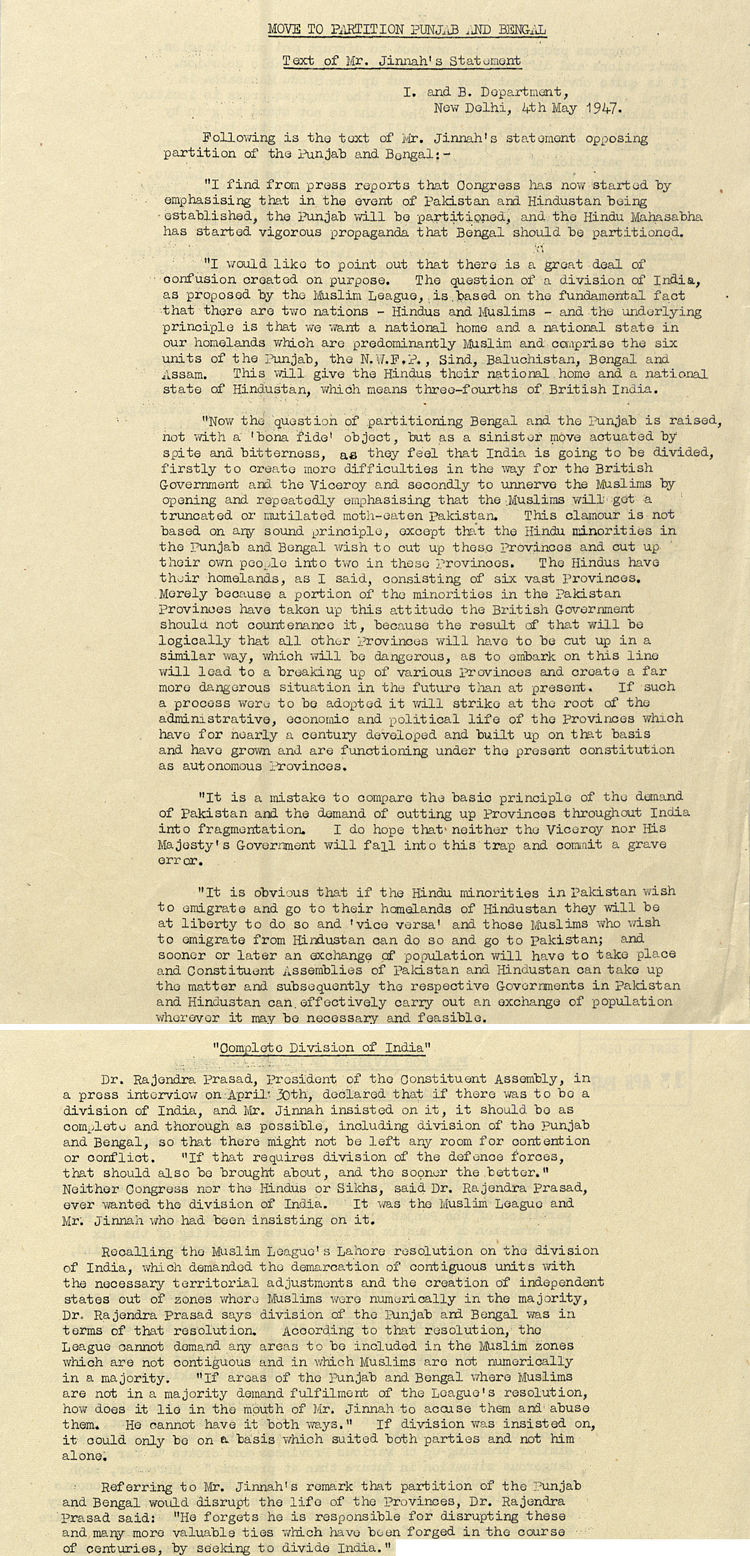
Indeed on his deathbed Mr. Jinnah admitted that he had committed a great blunder by creating a "mutilated, moth-eaten" Pakistan.
Drona, August 2012. PashtunForums 

For additional reading see the follow-up post: Two Muslim Theory

Wednesday, 15 August 2012

Partition: 1947

This post coincides with the 65th anniversary of 'Independence' - that point in 1947 marking the end of the British Raj and the division of the Indian subcontinent into the Union of India and the Dominion of Pakistan. The entire subject remain complex though over the next couple of posts, I hope to explore a few thoughts and opinions on the matter. In this post I begin by starting with a brief history.


British Colonial administration did not directly rule all of "India". There were several different political arrangements: Provinces were ruled directly and the Princely States had varying legal independent arrangements.The Indian National Congress formed in 1884 by a mixture of Indian (Hindu and Muslim) and English activists led for the initial calls to have more Indian representation within the administration.

By 1906 the All India Muslim League had been formed in Dhaka in reaction to what some elite Muslims viewed as Hindu dominance in Congress. As the appeal of Mohandas Gandhi and the Free India movement increased, a number of different scenarios were proposed. Amongst the first to make the demand for a separate state was the philosopher Allama Iqbal, who, in his presidential address to the 1930 convention of the Muslim League, proposed a separate nation for Muslims.

The 1946 Cabinet Mission aimed to reach an agreement between Congress and the Muslim League amid growing tension. Nehru, leading Congress was unwilling to accept a decentralised state and Jinnah, leading the Muslim League (made up largely of the 'secular' landed Muslim elite) returned a demand for Pakistan as a bargaining chip. Initially most Muslims opposed partition and there was no pre or post Pakistan 'plan' right up to the announcement in June 1947 that the British had set a date for handover.

Religious communalism fuelled the British decision to exit early (Lord Louis Mountbatten having just been made Viceroy of India in February 1947) and sealed - by accident - the decision to partition the subcontinent. Sir Cyril Radcliffe never having visited India before was employed to draw the boundaries between the two states in July 1947 five weeks before the end of British rule. On August 15 1947, India was granted her independence, and Pakistan the day before. Note, this was before Radcliffe Boundary Committee had made the announcement on the boundaries and before either country knew their borders. Significantly, partition led to the biggest sudden movement of people in human history  - with up to 12 to 15 million people uprooted within a short period and the after effects felt for years.

More in my next postings ...

Monday, 14 November 2011

7 Billion People

The version of the story that appeared in the Guardian was, overall, rather gloomy. Perhaps there is reason to be. Against a backdrop of global economic woe and with limited resources, the Guardian reports that Planet Earth has become Planet Humanity. 

Officially, there are now 7 Billion People on Planet Earth. The growth in numbers illustrates this point. In October 2011 there were 1 billion more people than in October 1999. Humanity hit the "first billion people" mark in the early 19th century and then another 1.5 billion followed over the next 150 years. The rapid spike upwards continued over the last 60 years as the world's population grew another 4 and half billion.

To a point, the fear about over-consumption has validity, but do we exercise fairness when we talk about striking a balance? After all, the vast majority of people on the planet - whether populations are expanding or not - live with relative humbleness. The gloomy scenario is that not everyone can live like the capitalist industrialised west. True, there may be some limits both in the ability to deliver fossil-fuel power/temperature-controlled lifestyles, and the desirability of this, but surely people in the developing world have the right to strive for better - clean water, reliable transport links and overall quality of life.

We - the people - are part of the natural backdrop of this planet and as Mohandas K. Gandhi said: "Earth provides enough to satisfy every man's need, but not every man's greed." 

Enjoy the film:


7 Billion People graphic taken from RobertBorkowski.com

Monday, 14 February 2011

A Conversation Between Two Great Men

When I reflect on the continuing turmoil that surrounds the lands of my people, I think of how far we have strayed from Bacha Khan's vision. I take comfort, however, in these words here - the possibility - the hope and the belief of who we are. Here's an excerpt of a conversation between Mahatma Gandhi and Bacha Khan, two incredibly great men:

BACHA KHAN: Gandhiji, you have been preaching non violence in India for a long time now, but I started teaching the Pathans non-violence only a short time ago. Yet, in comparison, the Pathans seem to have grasped the idea of non-violence much quicker and much better than the Indians. Just think how much violence there was in India during the war in 1942. Yet in the North West Province, in spite of all the cruelty and the oppression the British inflicted upon them, not one Pathan resorted to violence, though they too possess the instruments of violence. How do you explain that?

GANDHIJI: Non-violence is not for cowards. It is for the brave and the courageous. And the Pathans are more brave and courageous than the Hindus. That is the reason why the Pathans were able to remain non-violent.

Read more.

Monday, 17 May 2010

Thirsty World

Earth provides enough to satisfy every man's need, but not every man's greed. ~ Mohandas K. Gandhi

The fundamental notion that environmental sustainability is only achievable through mass control on population growth, is one that needs some challenge. The reason is simple. People are not the problem. It is consumerism that strips the earth of the ability to recover in time, that is.

One of the 2015 Millennium Development Goals is Environmental Sustainability and interestingly, whilst many of the development goals look at what is happening in the developing world, here is one for the industrialised nations of the world. It is about balance, not necessarily about whole-scale reduction in lifestyle, but that key realisation that as Gandhi says, "is about satisfying need, not greed."

When we consider that fashionable "designer" waters are predicted to be an $86.5 million industry by 2011, let's also bear in mind that 42% of the rural poor around the world, still, don't have fresh, clean drinking water and that 2.6 billion people do not have access to safe clean sanitation on a planet that where the land surface is 70% water. There is plenty of water, but much, much, work to do.

Saturday, 30 January 2010

One People

In response to a reader letter to his publication Harijan in 1939, Ghandi wrote this reponse. Readers of this blog will be able to figure the political position posed by the writer of the letter, but here I admire how Gandhi clearly understood the universality of people. His answers take the form of questions and the message - from any perspective - Hindu or Muslim - remains relevant today, over 62 years after Gandhi's death on 30th January 1948.
Why is India not one nation?

Was it not one during, say, the Mughal period? Is India composed of two nations? If it is, why only two? Are not Christians a third, Parsis a fourth, and so on? Are the Muslims of China a nation separate from the other Chinese? Are the Muslims of England a different nation from the other English? How are the Muslims of the Punjab different from the Hindus and the Sikhs? Are they not all Punjabis, drinking the same water, breathing the same air and deriving sustenance from the same soil? ...

... The way suggested by the correspondent is the way of strife. Live and let live or mutual forbearance and toleration is the law of life. That is the lesson I have learnt from the Quran, the Bible, the Zend Avesta and the Gita.

Wednesday, 27 January 2010

... the truth is the truth ...

Quotes from Mahatma Gandhi:


"A 'No' uttered from the deepest conviction is better than a 'Yes' merely uttered to please, or worse, to avoid trouble."

"First they ignore you, then they laugh at you, then they fight you, then you win."

"We may never be strong enough to be entirely nonviolent in thought, word and deed. But we must keep nonviolence as our goal and make strong progress towards it."

"Even if you are a minority of one, the truth is the truth."

Thursday, 19 November 2009

The End of Poverty?

Eight Million People

8 million people die each year because they are too poor to survive and yet the tragedy is that with a little help, they could even thrive. We can banish extreme poverty in our generation.

In his book, The End of Poverty, Jeffrey Sachs argues that extreme poverty — defined by the World Bank as incomes of less than 1 dollar per day — can be eliminated globally by the year 2025.

The End of Poverty, is now a documentary film: Here's a clip that reminds us all that Poverty is Not An Accident.

The End Of Poverty? from Philippe Diaz on Vimeo.

As Gandhi, once said, "The world has enough for everybody's need, not for everybody's greed."

Wednesday, 14 October 2009

Badshah Khan: A Torch for Peace

Yesterday evening, I saw the film The Frontier Gandhi: Badshah Khan, A Torch for Peace, which played at the Marina Mall as part of the Middle East Film Festival, Abu Dhabi 2009. The film is an amazing documentary on the life of the Khan Abdul Ghaffar Khan, a towering giant of heart and stature who was, is and will always remain a Pashtoon King of Peace, known as Badshah/Bacha Khan. He was a key figure in the Free India movement and this of course, invited the wrath of the British, even towards his peaceful cause.

As a Pashtoon, Bacha Khan showed the people that he loved a very different way - he challenged the opinion that Pashtoons could only be known for the gun and as a result could only remain backward. Bacha Khan was a good friend of Mahatma Gandhi and, like Gandhi, managed to mobilise the masses to resist injustice through peace. His movement of Khudai Khidmatgars (Allah's helpers) were taught to stand on their feet and bring about a positive change in themselves and their society through peace and social work. In the film, his daughter talks about his 'love for the poor people'.

Peace: Long live the King

His peace movement invited trouble and for a third of his time on earth, Bacha Khan was prisoner of conscience - in 1962 he was named by Amnesty International as Prisoner of the Year - overall for every three days of his life, he spent one day in British or Pakistani jails, often in solitary confinement. He continually challenged the validity of the British laid-down borders and later found sanctuary in Afghanistan - a natural home for the Pashtoons, travelling extensively and asking to be buried in Jalalabad when he was dying. When Bacha Khan's family said it would be difficult to arrange visas to cross the border, his reply to his family was "One day all this will be one".
Related Posts Plugin for WordPress, Blogger...