What do they say?
Wednesday, 15 February 2012
Bloody Valentine
What do they say?
Friday, 3 February 2012
The Boys Who Walked to Europe
"Water," he says. Where was he walking
in water? Mohammed, the boy on the next bedroll who knows more English,
translates. "In the mountains," he says. Which mountains, I ask,
thinking about the range that forms the border between Turkey and Iran.
"Croatia, Slovenia, Italy,'' Morteza says. Mohammed intervenes. "Not
water,'' he clarifies. "Snow." Suddenly I understand. Morteza's feet are
not waterlogged or blistered. He has limped across Europe with
frostbite.
Morteza's 13-year-old cousin Sohrab, pale and serious beyond his years,
recounts, in English learned during two years of school in Afghanistan,
what happened. Monday, 14 November 2011
7 Billion People
The version of the story that appeared in the Guardian was, overall, rather gloomy. Perhaps there is reason to be. Against a backdrop of global economic woe and with limited resources, the Guardian reports that Planet Earth has become Planet Humanity. Officially, there are now 7 Billion People on Planet Earth. The growth in numbers illustrates this point. In October 2011 there were 1 billion more people than in October 1999. Humanity hit the "first billion people" mark in the early 19th century and then another 1.5 billion followed over the next 150 years. The rapid spike upwards continued over the last 60 years as the world's population grew another 4 and half billion.
Enjoy the film:
Thursday, 8 September 2011
International Literacy Day
Wednesday, 7 September 2011
Education: A Human Right
"Hope dims for universal education by 2015 … The total number of children out of school is … 69 million in 2008. Almost half of these children (31 million) are in sub-Saharan Africa, and more than a quarter (18 million) are in Southern Asia." (see The Millennium Development Goals Report, United Nations, 2010).
In their 2010 analysis, The Global Campaign For Education reported that if “current trends continue, the slowdown in progress in enrolments will mean that in 2015 there will be more children out of school than there are today. In addition, too often the quality of education on offer is very poor, leading to early drop-out and illiteracy”.
As we lead up to International Literacy Day, UNESCO report that in 2008, 796 million adults (15 years and older) could not read or write. The Right to Education Project state what many of us have come to expect from education, but one that we don't always see in real numbers.
"As well as being a right in itself, the right to education is also an enabling right. Education ‘creates the “voice” through which rights can be claimed and protected’, and without education people lack the capacity to ‘achieve valuable functioning as part of the living’. If people have access to education they can develop the skills, capacity and confidence to secure other rights. Education gives people the ability to access information detailing the range of rights that they hold, and government’s obligations. It supports people to develop the communication skills to demand these rights, the confidence to speak in a variety of forums, and the ability to negotiate with a wide range of government officials and power holders."
Friday, 29 July 2011
Hunger and Outrage
Whatever the reasons; whether it comes down the ongoing drought, the apathy of the rich industrialised nations to act, or because the Horn of Africa appears to be locked in desperate state of social and political chaos, it remains an outrage that there are people, who in this day and age - 2011/1432 Hijri - still die of hunger. Monday, 4 April 2011
One Laptop Per Child - Why?
Saturday, 2 April 2011
One Laptop Per Child - Mission
Saturday, 6 November 2010
To Be a Muslim
I extend my welcome to all Muslim and non-Muslim, old and new. Salaam and Marhaba.
There is the way it is - and the way it is supposed to be. These are very different things.
To be a contemporary Muslim is to know that we live in an imperfect world and that there are many pulls and distractions. Muslims must navigate their faith through the issues that test us daily. That is the way it is.
And of course there is the matter of image. Muslims don't get it easy in the press. Sometimes, Muslims are drawn towards apology and it can be exhausting attempting to apologise for every error made by every Muslim that is reported. Personally speaking, I sometimes feel that I am right out of apology.
I recognise the disappointing reality of inequality - that Muslims make up a good proportion of the world's poorest people who live in the grip of disinformation and confusion. This is not the way it is supposed to be but the way that it is. The modern media feeds on this and the bad press feeds bad policy, the unnecessary wars and continual confusion within.
And, Allah, of course, knows best.
Saturday, 11 September 2010
IX.XI
Nine years ago, this date - 9/11 - became immortalised in our common knowledge and the lexis of probably most the languages on the Earth.I love the American spirit.
I always have. Feisty, independent, accommodating and where people can live the dream. Nine years ago, The United States of America was hurt. There, I've said it.
I love the Afghan spirit.
I love the land of Afghanistan because the history is in my blood. The land that is and was Afghanistan gave rise to the Pashtoon people, my present and past. I love the Pashtoon way, no-nonsense, independent, accommodating, and a people who dream of so much more than they have. Nine years ago, the events in the US meant that the Americans invaded Afghanistan. The country is still hurting. For so many, the wounds are open, exposed and infected.
For that dynamic alone, we should remember 9/11.
For now, that is.
But one day, I hope we can free ourselves from this past. One day, I hope, that we learn to understand that ordinary Afghans had nothing to do with the events in New York and Washington. I hope that people are allowed to mourn their losses in private without a date being used to divide us into polar opposites.I hope that in letting go, we reach an understanding that all is not what it appears. I hope that the innocent are not punished for that that they didn't do. I hope that those with power understand that we must ensure the safety of each other, but allow people to find their own way. I hope that people are not so poor that they are vulnerable to being manipulated for the selfish motives of others.
And I hope that one day when we are free, we fully understand that collectively we are the custodians of the Earth and that collectively our freedom, prosperity and peace are mutual.
Note: The title for this entry is IX.XI. I have used the Roman Numerals to indicate today's date. Whilst I'm sure that others have discovered this before me, note that in Roman Numeral form, the date is of course a Palindrome and is read the same reading from the left or the right.
Saturday, 7 August 2010
Catastrophe
The worst floods in Pakistan's history have hit at least 14 million people, the government relief agency says. According to Gen Nadeem Ahmed, of the National Disaster Management Authority (NDMA), that figure only covers Khyber Pakhtoonkhwa and Punjab provinces. The full figure is likely to be much higher, with at least half a million evacuated in Sindh.

Monday, 17 May 2010
Thirsty World
Earth provides enough to satisfy every man's need, but not every man's greed. ~ Mohandas K. GandhiThe fundamental notion that environmental sustainability is only achievable through mass control on population growth, is one that needs some challenge. The reason is simple. People are not the problem. It is consumerism that strips the earth of the ability to recover in time, that is.
One of the 2015 Millennium Development Goals is Environmental Sustainability and interestingly, whilst many of the development goals look at what is happening in the developing world, here is one for the industrialised nations of the world. It is about balance, not necessarily about whole-scale reduction in lifestyle, but that key realisation that as Gandhi says, "is about satisfying need, not greed."
When we consider that fashionable "designer" waters are predicted to be an $86.5 million industry by 2011, let's also bear in mind that 42% of the rural poor around the world, still, don't have fresh, clean drinking water and that 2.6 billion people do not have access to safe clean sanitation on a planet that where the land surface is 70% water. There is plenty of water, but much, much, work to do.
Sunday, 16 May 2010
Every 3.6 seconds
More than 30 per cent of children in developing countries – about 600 million – live on less than US $1 a day and every 3.6 seconds one person dies of starvation. Usually it is a child under the age of 5.Poverty hits children hardest. The first, 2015 Millennium Development Goal is to work towards the reduction by half the proportion of people living on less than a dollar a day and to reduce by half the proportion of people who suffer from hunger.
Some of these are very much connected. For example, there is a natural connection between the goal to improve maternal health care and child health care and movements towards the reduction of poverty focussing on children would be connected to access to universal primary education.
This still remains a Millennium Promise by the UN. Is it possible?
Five years will tell.
Thursday, 13 May 2010
Millennium Development Goals
Without a major shift in how we run our economies and the politics of power and money, nothing much will change.When I read that in today's Bangladesh 40 percent of population of 150 million lives on less that $1 a day, I'm reminded that the UN Millennium Goals may end up being empty rhetoric. 10 years from the Millennium Summit in 2000 when the goals were agreed and with 5 years left to achieve them, I wonder at the vastness of the task.
I completely agree with the principles. I'm consumed by a kind of pessimism that means I can't see the change, unless there is that massive shift in economic politics in order to achieve this. To remind us of the goals that were agreed in 2000 (be achieved world-wide by 2015):
- Goal 1: Eradicate extreme poverty and hunger
- Goal 2: Achieve universal primary education
- Goal 3: Promote gender equality and empower women
- Goal 4: Reduce child mortality
- Goal 5: Improve maternal health
- Goal 6: Combat HIV/AIDS, malaria, and other diseases
- Goal 7: Ensure environmental sustainability
- Goal 8: Develop a global partnership for development
Saturday, 19 December 2009
Casualties of War
"Who would ever want to leave their home willingly?" asks Wilayat Khan. "In the end we had two choices - flee or die."We are sitting in the cramped three-room house he shares with his brother's family in the Pashtun-dominated neighbourhood of Sohrab Goth, on the outskirts of Karachi.
Mr Khan and his brother rented it after they fled their native South Waziristan. So far, it is thought nearly 15,000 people have fled to Karachi to escape fighting in South Waziristan.
Most settle on the outskirts and many find work as labourers, watchmen or in Karachi's Pashtun-dominated transport industry.
"For the time being, most of the families fleeing the conflict in the tribal regions cannot return home," says Ismail Mehsud, a young Pashtun politician in Pakistan's financial capital. "It's a vicious cycle - and the state appears unwilling to play its part," he says. "Just handing out blankets is not going to help. Increasingly, Pashtuns are being made to feel like second-class citizens."
Wilayat Khan agrees: "I thought all of Pakistan was our home. But more and more, I feel like a stranger in my own homeland."
Edited from this BBC report.
The picture is taken from a similar report from IRIN Asia and shows how IDPs like Alam and Farooq Khan are struggling to find work.
Saturday, 21 November 2009
Hunger, Poverty, Conflict
In a survey of over 700 people in Afghanistan (reported by the BBC), poverty was cited as the main reasons cited for the ongoing conflict.The report, by Oxfam, coincides with the World Food Summit that ended on November 18th (and seen, rather pathetically now, as not entirely successful in addressing food 'shortages') and the recent Jeffery Sach's inpsired film, The End of Poverty?
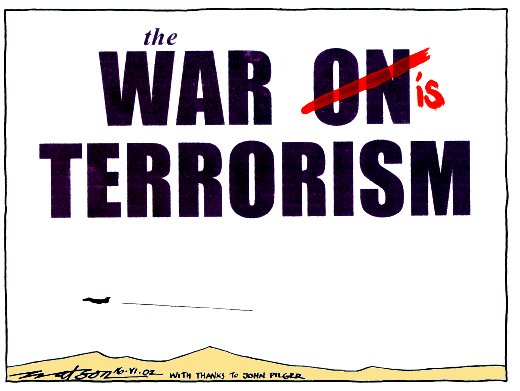
The war on terror lost direction a long time ago. What about a war on poverty, which is seen as one of the root causes of misery and conflict?
Thursday, 19 November 2009
The End of Poverty?
8 million people die each year because they are too poor to survive and yet the tragedy is that with a little help, they could even thrive. We can banish extreme poverty in our generation.In his book, The End of Poverty, Jeffrey Sachs argues that extreme poverty — defined by the World Bank as incomes of less than 1 dollar per day — can be eliminated globally by the year 2025.
The End of Poverty, is now a documentary film: Here's a clip that reminds us all that Poverty is Not An Accident.
The End Of Poverty? from Philippe Diaz on Vimeo.
Thursday, 12 November 2009
In a World of Plenty ...
The child pictured, from Pakistan, is a window cleaner and the sole breadwinner in her family. "Whatever I earn I give to my mother, and when I am a hungry, I eat at the food distribution centre." BBC NewsYesterday's media commentary on the UNICEF report, TRACKING PROGRESS ON CHILD AND MATERNAL NUTRITION raises some alarming statistics - over 90% of the worlds most undernourished children are in Asia and Africa with an estimated 195 million children in developing countries suffering from stunting and poor physical development as a result of undernourishment.
Undernutrition caused by poor feeding and care, aggravated by illness leads to a cycle of recurring illness and faltering growth – irreversibly damaging their development and their cognitive abilities, and impairing their capacities as adults. If a child suffers from diarrhoea – due to a lack of clean water or adequate sanitation, or because of poor hygiene practices – it will drain nutrients from his or her body.
And so it goes, from bad to worse: 1 billion people world-wide are undernourished. and hungry. Children who are weakened by nutritional deficiencies cannot stave off illness for long, and the frequent and more severe bouts of illness they experience make them even weaker. A third of all deaths of under 5s is related to undernutrition.
Fifty-nine percent of under-5s in Afghanistan show signs of moderate to severe stunting and comes out as the country where percentage wise, its the highest. India, Nigeria and Pakistan also have percentages in their 40s.
In a world where there are people over-eating, and too much of our food is wasted, it is outrageous that globally, as we approach 2010, we still have instances when our children go to sleep hungry at night.

Sunday, 2 August 2009
Madrassah

I went to a madrassah a couple of days ago where boys and girls are housed free of cost and schooled in an Islamic education. This was quite a 'modern' madrassah with computers as part of the standard education - the students in school were pulled in from varying regions and represented a cross section of the different ethnic groups in Pakistan. Technology classes hadn't started yet, so it would have been interesting to see how this was applied to the students' learning. What was clear was how the school was open about its missionary purpose - it was run by a group of Sunni Gilgitis, themselves a minority in the Ismaili Shia dominated northern tip of Pakistan.
Madrassahs have come under the spotlight, of course, because they are funded by non-government sources and are often pointed at for churning out the next batch of suicide bombers.
Whatever the truth, present and past governments have an abysmal track record on education spending. The education budget counts for peanuts, so surely the blame lies not with the madrassahs but with successive Pakistan governments for whom education has not been a priorty.
Thursday, 30 July 2009
Poverty: Roots/Causes

Somebody must do something. Are you listening, politicians of Pakistan?
The photo is actually of a beggar from Udaipur, but it serves the purpose of illustrating the kind of approach that is made daily on my regular commutes around Karachi.