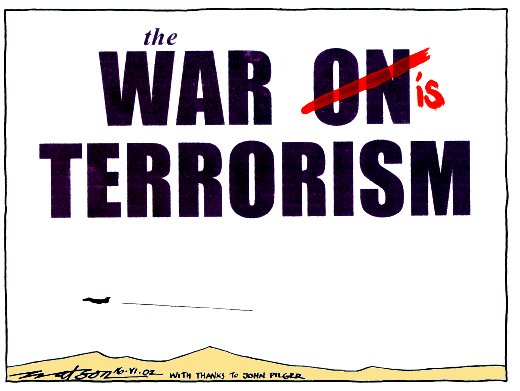
Showing posts with label Terrorism. Show all posts

Wednesday, 29 May 2013

Murder and Apology

In the hysteria and media vulturism that has surrounded the murder of Lee Rigby, I still feel that this post comes too soon. The family of the dead soldier needs time to grieve, the space to support each other and to make sense of the situation. The media is not as forgiving however and sensationalism grabs the headlines. Much as I try to resist being drawn in, eventually I feel that I should also voice a comment.

I'm at odds with the media adopting extreme views, but I'm also at odds with jumping on the bandwagon of apology or justification. These are not appropriate responses. Lee Rigby was murdered in cold blood, in a most gratuitous and savage manner by assailants who had somehow been dehumanised. That act of absolute unashamed brutality, the immediate events leading up to it and the delayed response of the authorities should be under the media and investigative microscope. For the same reasons, I made a decision not to comment on the Boston attacks the Woolwich murder has led to Muslims being rolled out onto the social media platform to apologise or distance themselves from acts of terror (murder). This is a type of approval seeking and constant apology is something that I do wish to entertain. Frankly, I sense inferiority when this has to happen and I'm bored with it. Murder of someone innocent is murder. It is heinous and it deserves a just punishment. That is true if some white Norwegian is behind this or some deranged  men on the streets of London are behind this. Individual acts like this simply do not represent all the members of a society. It creates an unnecessary pressure to be apologetic. Would we also call it murder if the innocent are killed by soldiers in combat? That perhaps is a rhetorical question, though it is one I could come back to in a future post. Right now, this apology by the BBC's Nick Robinson - where the killers in the Woolwich murders were described as having a 'Muslim appearance' - has the sad potential to be almost comic.

Read Areeb Ullah's take on this.

Image Source: Real Street

Sunday, 21 October 2012

ملالې تا خو لر او بر وژړو

Dedicated to Malala Yousafzai 


ملالې تا خو لر او بر وژړو
هم دې شمساد هم
دې خیبر وژړو
یه د هلک په وار پیدا ملالې
نن د افغان هر ټبر دې وژړو
د پښتونخوا هر بوټی ګل خپه دی
تا خو د ګرد وطن هر غر وژړو
ستا د قلم زوره نن خبر شو
د تور تمیانو دی لښکر وژړو
مئندې زامن نه، لوڼې غواړي
نجوني خو ژاړي تا هر نر وژړو
کاش د ضیا په ځای کي زما لورکئ وی
د وطنپال خو د
ې ځیګر وژړو

http://www.facebook.com/watan.pal

Friday, 19 October 2012

The Tragedy of Malala


In this climate of agendas, I admit to some confusion about what I am being told and it is never always absolutely clear what is the truth; and what is blatant propaganda. Over the years, and particularly since I began this blog I have been offered many loose ends and have read way too many conflicting accounts to be sure all the time. This makes the events surrounding Malala Yousafzai's shooting all the more tragic. Primarily I pray for her speedy recovery and condemn the bigotry that led to her shooting. May Allah bring peace and justice to all those caught up in the ongoing war and the acts of terror in the Pakistan-Afghanistan belt. May people be afforded the right to go about their business according to their faith and conciousness free from the threat coercion or attack. Ameen. 

Part of me cannot escape noticing the ring of political and media exploitation surrounding Malala's life, or even the fact that the girls who were shot with her, Kainaat and Shazia, are all but forgotten. There is no doubt that these are remarkable individuals and I keep them all in my prayers. Out of the tragedy, I wish to see these girls strong in their resolve - to acquire the education that has been the cause of the controversy in Swat and to be part of that change that will allow them as Pashtun women to be the social equals that men and women in Bacha Khan's vision were meant to be.

This is an important parallel. Bacha Khan recognised the crucial need for education amongst the Pashtuns - for both men and women and Malala would embody that. She bravely stood up to intimidation when girls' schooling was banned in Swat and in doing so adopted a very political position. I offer this with a little caution however. To be political is one thing; to be caught up in someone else's politics is something else. Since the fall of the Taliban in Swat, Malala has been courted by the Pakistani and the world media with their varying views  - all wishing to push their own messages through her.

Note this quote from BBC World TV documentary about her made two years ago. She is twelve years old at the time.
Malala: “I want to ba a doctor but my father told me you have to be a politician. But I don’t like politics.”
Father: “My daughter can be better than a doctor.”
Malala's desire for an education was genuine and highly commendable; but she was thrust into the firing line by an ambitious father and an ambitious documentary maker apparently unconcerned by her direct statement that she was being manipulated against her will.

Having been shot, Malala has now been airlifted and is receiving world class treatment in Birmingham, England. I hope that she recovers and in the long term goes on to a happy and fulfilled life as a doctor. For most children caught in the 'War on Terror', however, the story is very different. The truth is that Malala is not getting this treatment because that is what is done for children attacked in Afghanistan and Pakistan. She is getting this treatment because she became, and remains, an exploited propaganda symbol. If people really cared about Pashtun children, Malala would not be a public figure in the way that she now is. Pashtun children would not have to 'fight' for their right to education and nor would they be filmed fighting for their lives in hospitals.  

Read this view for more thoughts on this story. 

Wednesday, 25 July 2012

Letter to Blair Inc.


We seem to thrive on fear and this is especially true of what many 'westerners' think when it comes to what the Islamic world represents. Whilst the Islamic world has certainly had a past cultural glory when it made contributions to the arts, mathematics and sciences, even with this, there's the historical record of western prejudice against Muslims (see Orientalism). So whether one's opinions originate from a historic Christian set of values or a modern liberal or politically Eurocentric set of values, there is likely to be some point of difference/conflict with a given view in Islam. Adding to that the fear mongering, as in the interview here, and the type of responses that it provokes invariably there is a lack of a balanced and thoughtful judgement when it comes to Muslim-Christian (read 'western') relations.

In this interview with The Telegraph, former British Prime Minister Tony Blair continues to peddle the same old fear with his opinions on 'militant Islam'. I am not going to deny the marginalisation and subsequent radicalisation of Muslims and nor do I excuse it. It is wrong in fact - but one needs to consider the historical relationships of the east and the west to understand why differing sides are often caught up in conflict. A deep misunderstanding and fear continues to inform the way Islam is perceived and both the west and the Muslim world need to self-reflect to consider how their own actions affect the other. I will say however, for there to be a meaningful dialogue that the major need for self reflection vis-à-vis the other should come from 'Christian' west, who must come to terms with their own historical bias and personal animosity.

This might have nothing to do with how he feels, but Tony Blair is a 'new' Catholic and without doubt, a career politician. He knows how to draw attention to the fears/thoughts of middle England and exploit them for his own purposes. I wonder, if many readers of commentators on The Telegraph interview realised that Tony Blair's sister-in-law, Lauren Booth, is in fact, a Muslim? (She spent time in Iran). Mr Blair, himself is now, a somewhat lacklustre international figure. He has, by all accounts, been a low-impact UN peace envoy to the middle east and all indications are that he has profited healthily from this 'unpaid' position. 

Just goes to show, that with a little manipulation, the old forms of hatred and bigotry surface in order to wage contemporary political battles.

Image Credits: ShaneBertou

Friday, 24 February 2012

Ten Years of Meltdown

Another bomb explosion in Peshawar yesterday claimed yet more lives. Like the explosion in the Khyber tribal district not long back, this happened whilst people waited for a bus. Sadly, this comes less than a week after sectarian violence in Parachinar and today gunmen stormed a police station, again in Peshawar, leading to yet more killing. I can't help but think that right now, it doesn't really matter any more what the faith denomination, ethnic background or political slant of an individual is, in Pakistan - something is seriously malfunctioning. Whilst ultimately violence is indiscriminate; Peshawar, Khyber, Swat, Parachinar, Waziristan, Bajaur and much more, is Pashtoon land and when we turn our violence upon each other, I feel hurt and confusion. At times it feels that we are going down like flies. And I continue to ask why.

Ahmed Rashid, writing for the BBC describes the past ten years perfectly when he says that Pakistan is in Meltdown.  He writes that ten years after becoming embroiled in the US "War on Terror", Pakistan, mired in scandal, may have to face some kind of unilateral US action. This has long been conjecture, but let's face it, when the US enters Pakistani airspace with its drones, this results in civilians being killed. The Raymond Davis shoot-out saw Pakistan bowing to US pressure - thus effectively creating an immunity for American intelligence to kill on Pakistani soil, seemingly without impunity and of course, most infamously Osama bin Laden was hunted down and killed in Abbotabad, whilst Pakistan was asleep. All of these represent US action against Pakistan, whether anyone cares to admit it or not.

But of Pakistan itself - why is it headed towards meltdown? I have a theory. Rather simplistically much of Pakistan's past, present and future woes stem from its schizophrenic relationship with India and how this is dealt with. And yes, there is mass poverty, economic ruin, natural disasters, ethnic unrest and wide-scale political corruption at home. Everything in Pakistan is negatively over politicised - the intelligence services, militant groups, the judiciary, redrawing of provincial boundaries, college campuses, religion, the media, municipality services, the ordinary man on the street and of course, the military. 

Notice there that even whilst discussing this, I didn't even get to politicians. They of course, knowingly sit there in Pakistan temporarily or in exile to escape criminal or corruption charges, watching as everything melts before them.

 
 Cartoon by Satish Acharya

Saturday, 17 December 2011

Zarteef Afridi Khan

Just a few kilometers from the municipal limits of Peshawar, Jamrud lies in the Khyber Agency tribal territory where the law of Pakistan does not hold. Here the Pashtoon code of conduct holds sway. Display of weapons is a matter of pride in a land where education has taken a back seat for most. On 8 December 2011, human rights defender Mr Zarteef Afridi Khan was shot dead by unknown gunmen in Ghundai area near Jamrud Bazaar while he was on his way to work at a local government-run school where he served as headmaster.

Prior to his murder, Zarteef Afridi had been active as the Human Rights Commission of Pakistan's core group coordinator in the area. Apart from his role in HRCP, Zarteef Afridi had been active with a number of peace groups in campaigning for the release of dozens of prisoners under the Frontiers Crimes Regulation.

He was known for his pacifism and his commitment to the cause of education he began his teaching career in 1983 when he was prevented by his mother from from going to Soviet Russia for a degree in engineering. His commitment to the cause of human rights meant that he became a vocal advocate of equal rights for minorities, women and children and his campaign for the release of people jailed under the Frontier Crimes Regulations won him the respect of the people of Jamrud. In the mid 90s Zarteef Afridi coupled his teaching with activism through the platform of Democratic Commission for Human Development.

It is reported that Zarteef Afridi had been receiving death threats from local militants for his work in organising a congregation of tribal elders.

Teacher, Human Rights Activist, Social Worker.
Killed December 2011

Saturday, 5 November 2011

Smoke and Mirrors

Smoke, Mirrors  ...

November the 5th. Bonfire. Guy Fawkes. The tendency is to understand these as synonymous. The popular version of the story, beginning with a failed assassination attempt (led by Robert Catesby and supported by Guy Fawkes) is one that has familiarity, but there's something more that needs a little thought.

Bonfires (historically, the Celtic 'bone fire') stemmed from the traditions of burning waste after the autumn harvest and marked an annual pre-winter rite of passage. The contemporary version was reinforced by the Thanksgiving Act 1605 (also known as the Observance of 5th November Act) and ties in with infamous Gunpowder Plot. Look a little deeper at this and then this date is not just about the saving of King James I. It becomes the macabre 'celebration' of the death of a man who was hung, drawn and quartered following a trial for high treason.

And there is perhaps another rather ambiguous aspect to all this that might get overlooked. Is November 5th a celebration of victory over terrorism or the celebration of the terrorist himself? The popular media and the average Brit probably don't pay much thought to this possibility and are quite willing to live with a slightly over-romanticised idea of toffee apples and fireworks. But just a thought - imagine a similar date set aside for Osama bin Laden.

... and Vendetta

The transformation of rebel to iconic hero is where Guy Fawkes' legacy now lies. During the recent anti capitalist protests, the image of Guy Fawkes, like the one worn as a mask by the unnamed protagonist in the film V for Vendetta, took on a contemporary symbol of resistance. Turns out that Guido Fawkes, the great anti-government rebel, would-be assassin and terrorist, wins after all.

Oh, and my favourite quote from the film? 

"People should not be afraid of their governments. Governments should be afraid of their people." 

Perfect.

Sunday, 11 September 2011

Never Ending Story

11.9.11

Do I dare put on the television, switch on my computer or pick up a newspaper on a day like this? I, like millions across the globe, have expressed sadness and regret for what happened on this date 10 years ago and how the death and destruction associated with this date continue to haunt us.

The constant media reminders turn the 9/11 attacks into a tragic story of division and misery seemingly without end and this is the thing that troubles me the most. Any credible observer would come to the conclusion that Afghanistan and Pakistan have been brought to their knees by the war on terror and the Pashtoons have suffered the 'most' from the aftermath. 

This isn't about forgetting, but letting go. Last year I wrote: 
I hope that in letting go, we reach an understanding that all is not what it appears. I hope that the innocent are not punished for that that they didn't do. I hope that those with power understand that we must ensure the safety of each other ...

... And I hope that one day when we are free, we fully understand that collectively we are the custodians of the Earth and that collectively our freedom, prosperity and peace are mutual.
Dedicated to Ahmed Omed Khpulwak, BBC Pashto Journalist, killed by a US solider who 'mistook' him for a suicide bomber, July 2011.

 احمد اميد خپلواک

Saturday, 14 May 2011

Global War: Local Cause?

More than 100 dead; many more injured. 


There is a terrible inevitability about the twin bombings in Charsadda, yesterday morning. Little about it is different from previous bombings. There is the same vicious tactic of two devices - one designed to kill helpers moments after the first blast. There is the familiar target: recruits to the underpaid, under-equipped paramilitary frontier corps. There is a familiar culprit: the Pakistani Taliban, who claimed the attack.

The difference is that this strike comes after the death of Osama bin Laden. It is an attack, claimed in the name of al-Qaida, by Pakistanis on Pakistanis. I'm not the sympathiser, the analyst, nor the strategist here, but I do have a question.

Why?

Why is it that we live in a world where the region to which I owe my personal history continues to be caught up in a war without end? Why is it that Pakistan and the US continue with a delusional marriage that aggravates the suffering? Why is it that Pashtoons appear to be caught up in someone else's war? Why is it that Islam ("peace") has increasingly little to do with this? Why?

The story goes that Osama bin Laden is dead, killed in a secret raid that may/may not have had Pakistani involvement and one that continues to raise questions on the legitimacy - should the US have entered sovereign territory; should bin Laden have been captured and tried; what was the exact narrative of events? Many questions unanswered and perhaps for another time.

But for now I wish to understand the whys I raised earlier. Jason Burke, writes in The Guardian that Osama's "strategy, happily, was not always a successful one ... [many groups across the Middle East] ... rejected Bin Laden's advances, as did others throughout the Far East, the Balkans, the Caucasus and Central Asia."

Global War: Local Cause?
But of those that did sign up, there is a decidedly local dimension which appears first. The global brand of terrorism, such as the Tehrik-e-Taliban-Pakistan, who were responsible for an attempted bombing in New York last year have hitched their local cause to the broader one – against the "Crusader Zionist alliance" or their local hypocrite, infidel, apostate stooges (in this case the Pakistani government and military and all who work for them).

In his article, Burke makes the key point about the appeal for radical groups not being universal across the Muslim world, but points out that "the global language usually disguises local weakness. That of the Pakistani Taliban is that they are not a conservative traditional group battling to preserve age-old customs but a bunch of marginalised men from smaller tribes, without education, without positions in the social hierarchy and who would be nothing without the power of the gun."

... Above all, what the invocation of a dead Saudi-born terrorist's name is aimed at disguising is the truth about the various conflicts that have been conflated into the narrative, in Washington as much as in compounds in Abbottabad, of one single civilisational clash.

In fact, there is no single conflict, simply a nasty mesh of individual wars, most of which pitch countryman against countryman, in Iraq, in Afghanistan and in Pakistan."

Monday, 2 May 2011

Osama, Dead.

This is not a good day for Pakistan, despite the announcement of the death of Osama Bin Laden. 

The compound in Abbotabad that Osama Bin Laden was found in was reported to have had high walls, barbed wire and security cameras. Did the intelligence arm of the Pakistan military - the Inter Services Intelligence Directorate (ISI) know he was here less than a 1km away from a military academy?

Since 2005, the US authorities have become increasingly persuaded that the ISI has taken an "a la carte" approach to terrorist groups - picking and choosing which group to support.

Crudely, this boils down to whether the groups act as a hedge against the growing regional influence of India.

Billions in aid is sent every year to Pakistan and if the US assessment is that there were elements within the ISI who did know where Osama Bin Laden was hiding, US relations with Pakistan - already severely strained - could reach crisis point.

... Oh and ... whilst I do know better than to join the conspiracy theory wagon, exactly where are the photographs that prove the death yesterday ...?

Saturday, 11 September 2010

IX.XI

Remembrance And Hope

Nine years ago, this date - 9/11 - became immortalised in our common knowledge and the lexis of probably most the languages on the Earth.

I love the American spirit.

I always have. Feisty, independent, accommodating and where people can live the dream. Nine years ago, The United States of America was hurt. There, I've said it.


I love the Afghan spirit.

I love the land of Afghanistan because the history is in my blood. The land that is and was Afghanistan gave rise to the Pashtoon people, my present and past. I love the Pashtoon way, no-nonsense, independent, accommodating, and a people who dream of so much more than they have. Nine years ago, the events in the US meant that the Americans invaded Afghanistan. The country is still hurting. For so many, the wounds are open, exposed and infected.


For that dynamic alone, we should remember 9/11.

For now, that is.


But one day, I hope we can free ourselves from this past. One day, I hope, that we learn to understand that ordinary Afghans had nothing to do with the events in New York and Washington. I hope that people are allowed to mourn their losses in private without a date being used to divide us into polar opposites.

I hope that in letting go, we reach an understanding that all is not what it appears. I hope that the innocent are not punished for that that they didn't do. I hope that those with power understand that we must ensure the safety of each other, but allow people to find their own way. I hope that people are not so poor that they are vulnerable to being manipulated for the selfish motives of others.

And I hope that one day when we are free, we fully understand that collectively we are the custodians of the Earth and that collectively our freedom, prosperity and peace are mutual.

Tor_Khan تور خان

Note: The title for this entry is IX.XI. I have used the Roman Numerals to indicate today's date. Whilst I'm sure that others have discovered this before me, note that in Roman Numeral form, the date is of course a Palindrome and is read the same reading from the left or the right.

Friday, 11 June 2010

As If Hell Fell On Me


The Taleban came here and settled here. Now they have a dispute with the government, and the government started taking actions against them. If we stand with the government the Taleban will hit us. If we stand with the Taleban the government will target us. If we don't stand with any of them, you can see how bad our situation is.
Four million people live under the grip of Taleban rule in Khyber Pukhtunkhwa and the FATA regions of Pakistan, 1 million are displaced and ordinary people are caught right in the middle. The 130-page Amnesty report, As if Hell Fell on Me, was based on nearly 300 interviews with residents of the Federally Administered Tribal Areas and the surrounding area. It tells the narrative of the suffering of the people.The government tells a story of success in its combat with the militants. Five million people, and probably a good few more, tell a different story.

Consider this comment by Amnesty International. It sums it up for me:
Most discussions of the conflict ignore the fact that northwest Pakistan is heavily populated and that the majority of people who live in FATA and other areas of northwest Pakistan do not support or take part in violence and are going about the business of trying to farm, raise livestock, weave fabrics, transport goods, raise families, and build, repair, or teach. The well-being of these civilians is rarely mentioned in media reports or policy pronouncements by Taleban or US, Pakistani, or Afghan officials and there are few signs that leaders on either side of the conflict factor civilians into their policies or strategic analyses.
The photograph of the old lady from Waziristan reminds me of a great-aunt of mine who was displaced in the Swat exodus last year. That single tear just breaks the heart.

Saturday, 15 May 2010

Who and Why?

The Hidden Enemy

Universal Primary Education is one of the Millenium Development Goals. I could write much more on this, but consider the picture here, taken from the BBC. It shows an outdoor school in an unidentified Pashtoon area. This, unfortunately is the plight of many Pashtoon children. These are the children who will, of course, shape the future.

In an earlier posting, I said I would return to this topic, so here goes. A report on BBC Pashto some weeks back began with:
په پېښور کې د اپريل په ١٩ مه نېټه د يوۀ ښوونځي د باندې چاودنه وشوه ، دا لومړى ځل نه و چې په خيبر پښتونخوا ، قبايلو يا د افغانستان په جنوبي ولايتونو کې ښوونځي په نښه کېږي

On April 19th in Peshawar, there was an attack on a school. This is the not the first time this has happened to schools in Khyber Pakhtoonkhwa, the Tribal Areas or the southern provinces of Afghanistan.

The question that was asked was:
پښتني سيمو کې ښوونځي څوک خرابوي او ولې ؟
Who* is attacking schools in Pashtoon areas, and why?

The responses to the question spoke of an "enemy" working to prevent Pashtoon educational progress. Who this enemy is - was not really identified, so the question about who* is behind the attacks remains. Fingers continue to point, but without knowing who the enemy is, can it be possible to begin to work out a solution?

For me, as an educationlist, and a Pashtoon, this is particularly troubling.
خادم الافغان- کابل
څرګنده ده چې د پښتنو د ښوونځیو سوځول د پښتنو د دښمنانو کار دی. دوی نه پرېږدي چې پښتانه له تعلیم برخمن شي
Khadim Al Afghan - Kabul
Apparently, the buring of Pashtoon schools is the work of the enemies* of the Pashtoons. They do not want Pashtoons to be educated.
حکيم الله ـ هندوستان
دوی د پښتنو په سيمو کې ښوونځي سوځوي، ځکه چې پښتانه يووالی نه لري، دوی نالوستي او د افغانستان دښمنان دي، دوی په دې کارونو سره امتياز اخلي
Hakimullah - India
They* can burn schools in Pashtoon areas because the Pashtoons are disunited and they* are the enemies of [ending] illiteracy and Afghanistan. It is to their* advantage to do this.

*whom exactly?
Tor_Khan تور خان

Thursday, 28 January 2010

London Calling

The Taliban leadership do not have as their principal aim al-Qaeda's violent global jihadist agenda

Mmm ... tunes change ...

In 2001, the Americans blurred the lines between the Taliban/Al Qaeda and in the process also confused Pashtoon interests with terrorism. It was always complex, but the net result is, nine years later, Pashtoons feel unrepresented, out of favour and vilified. The London Conference on Afghanistan is primarily about handover/withdrawal - call it what you like. At least that is the mood today.

From the BBC:

Talking with the Taliban is emerging as the big issue at the London conference. At first glance, it appears a simple idea - weaken the insurgency by luring away low and mid-level Taliban fighters. This - it is argued - could be done by offering jobs and a general amnesty for the insurgents. But it will be difficult - if not impossible - to pull off.

Part of the problem is that international forces (and the Afghan government) are struggling to understand who they are fighting and what is actually fuelling the insurgency here. And that raises the question: if you do not fully understand who you are fighting, can you hope to win them over?

Photograph from the Boston Globe

Tuesday, 19 January 2010

Pashtunistan Square

I despair sometimes.

Yesterday's bloodshed in Kabul's Chahr Rahe Pashtunistan [Pashtunistan Square] is an absolute example of our sorry state. A tragic waste of young life (and another blight on the name of the Pashtoons).

From the Wall Street Journal:

"We locked our shops and rushed outside. As we were running down, the armed men ran up the stairs to take positions on the top floor," said Mohammad Farooq, a 29-year-old shopkeeper. "Some vendors claimed to have seen these attackers, Pashto-speaking men in their 20s, visiting the center's top floor the previous day."

A thought from Bacha Khan: "O Pathans! Your house has fallen into ruin. Arise and rebuild it and remember to what race you belong."

Monday, 4 January 2010

700 Innocent Civilians in 2009

Ahmed Rashid, Lahore-based, journalist writing for the BBC:
Pakistan & Afghanistan Crisis: Pakistan

In 2010, Pakistan faces a triple crisis:
  • Acute political instability - President Asif Ali Zardari may be forced to resign, which could trigger long-term political unrest
  • An ever-worsening economic crisis that is creating vast armies of jobless youth who are being attracted to the message of extremism
  • The army's success rate in dealing with its own indigenous Taliban problem
The latter has been partially successful, but consider the figures reported by the Dawn Media Group:

Peshawar: Of the 44 predator strikes carried out by US drones in the tribal areas of Pakistan over the past 12 months, only five were able to hit their actual targets, killing five key Al-Qaeda and Taliban leaders, but at the cost of over 700 innocent civilians. According to the statistics compiled by Pakistani authorities, the Afghanistan-based US drones killed 708 people in 44 predator attacks targeting the tribal areas between January 1 and December 31, 2009.

For each Al Qaeda and Taliban terrorist killed by US drones, 140 innocent people also had to die. Over 90 per cent of those killed in the deadly missile strikes were civilians, claim authorities. The success percentage for the drone hits during 2009 was hardly 11 per cent. On average, 58 civilians were killed in these attacks every month, 12 persons every week and almost two people every day.

Ahmed Rashid continues:
Pakistan & Afghanistan Crisis: Afghanistan

The Pakistan military, which effectively controls policy towards India and Afghanistan, shows no signs of giving up on the sanctuaries that the Afghan Taliban have acquired in Pakistan. US success in Afghanistan is unlikely without eliminating these sanctuaries or forcing the Afghan Taliban leadership into talks with Kabul.

For the moment the army is hedging its bets with the Afghan Taliban, as it is fearful about a potential power vacuum in Afghanistan once the Americans start to leave in 2011. Other neighbouring countries - India, Iran, Russia and the Central Asian republics - may start thinking along the same lines and prepare their own Afghan proxies to oppose the Afghan Taliban, which could result in a return to a brutal civil war similar to that of the 1990s.

Is History about to repeat itself?

Friday, 11 September 2009

Malang Jan - وطن ژاړي - The Homeland Weeps

Malang Jan's poetry is amongst my favourite and in the wake of 9/11 reflection, I think his words capture the mood of a homeland* that is divided and asks questions of why this is so. I take these two lines from Watan Jaree وطن ژاړي (The Homeland Weeps).

وطن به ژاړي په قيامت زمونږ نيکونو ته

عرض کوي پلورنو ته، زه مو چا ته وم سپارلى؟

Watan ba jaree pa qiyamat zamung nikuna ta
Arz kawee plornoo ta, za mu cha ta wam sparley

On judgement day our homeland will weep before our grandfathers,
We ask the selle
rs, who handed us over?
Tor_Khan تور خان

On this very day, back in 2001, the Americans felt wounded following the attacks that the world now knows about and invaded Afghanistan shortly after. In 2009, I can safely say that the American plan for Afghanistan and Pakistan is in a state of confusion. Osama Bin Laden seems to have dropped off the agenda and instead Americans and NATO have strained relationships with the people on the ground. Crowds, at weddings, funerals and prayers are vulnerable to missile attacks from the skies and US intentions are met with a genuine scepticism. What happened to the confident promises of development and reconstruction?

The Taleban, never fully dismantled, emerge from the shadows as a "credible" resistance force. That the Americans don't admit that they are losing the battle in the Pashtoon heartlands troubles me. The Americans are not the only ones wounded. Today, the Pashtoons are being bombed back to the stone-age, our supplies are interrupted, we are forced to flee our homes, our tribal leaders are slowly being killed off and we are punished in a manner that the British colonialists called Collective Punishment (i.e. it's indiscriminate - we're all blamed for the militants).

Eric Margolis calls this a war on Pashtoons. Malang Jan Baba was right - who sold us out?

*In much of his poetry, Malang Jan writes about Pashtunistan.

Sunday, 2 August 2009

Madrassah


On a TV news item on the causes of terrorism in Pakistan, the matter of poverty and desperation came up - one comment was that ordinary folk became recruits for militant activity, because they didn't connect with the politicians in Islamabad who were too busy being chauffeured around in brand new Mercedes cars.

I went to a madrassah a couple of days ago where boys and girls are housed free of cost and schooled in an Islamic education. This was quite a 'modern' madrassah with computers as part of the standard education - the students in school were pulled in from varying regions and represented a cross section of the different ethnic groups in Pakistan. Technology classes hadn't started yet, so it would have been interesting to see how this was applied to the students' learning. What was clear was how the school was open about its missionary purpose - it was run by a group of Sunni Gilgitis, themselves a minority in the Ismaili Shia dominated northern tip of Pakistan.

Madrassahs have come under the spotlight, of course, because they are funded by non-government sources and are often pointed at for churning out the next batch of suicide bombers.


Whatever the truth, present and past governments have an abysmal track record on education spending. The education budget counts for peanuts, so surely the blame lies not with the madrassahs but with successive Pakistan governments for whom education has not been a priorty.
Related Posts Plugin for WordPress, Blogger...