Sunday, 25 November 2012

Day Of Ashura

Yaum Al Ashura (Day of Ashura) marks many important events to Muslims, both Shia as well as Sunni. Many Sunni Muslims, for example, observe a voluntary day of fasting to observe the day that Prophet Moses (AS) freed the Israelites from the bondage of the Egyptian Pharaoh.

Along with this Muslims also remember this day as one of the most tragic events in Islamic history. Yaum Al Ashura (Day of Ashura) commemorates the Battle of Karbala (in present day Iraq) on the 10th of Moharram (61 AH).

The battle marks the conflict between a small group of supporters and the family of Imam Hussein ibn Ali, son of Ali ibn Abu Talib and grandson of Mohammed (PBUH) and a much larger military detachment from the forces of Yazid I, the Umayyad caliph, whom Hussein had refused to recognise.

Hussein and all his supporters were killed, including Hussein's six month old infant son, Ali al-Asghar ibn Husayn, and the women and children of Hussein's house were taken as prisoners. The dead are regarded as martyrs by Muslims, and the battle has a central place in Islamic history and is frequently referenced in  Islamic literature.

The events leading up to the tragedy at Karbala are at the heart of the schism that followed between the early Muslims. Even today, we are not free from the divisions; so whilst they exist and sectarianism continues to hurt the Muslims; let us remind ourselves that Moharram is both the blessed first month of the Muslim calendar and an official month of peace. 

Thursday, 22 November 2012

A Family Is Like

A Family Is Like
© Nicole M. O'Neil

A family is like a circle
the connection never ends
and even if at times it breaks
in time it always mends

A family is like the stars
somehow there always there
families are those who help
who support and always care

A family is like a book
the endings never clear
but through the pages of the book
their love is always near

A family is many things
with endless words that show
who they are and what they do
and how they teach you so you know

But don’t be weary if it's broken
or if through time its been so worn
families are like that-
they're split up and always torn

But even if this happens
your family will always be
they help define just who you are
and will be apart of you eternally

  Dedicated to many many people ;)

Friday, 16 November 2012

Monday, 29 October 2012

The Durand Line


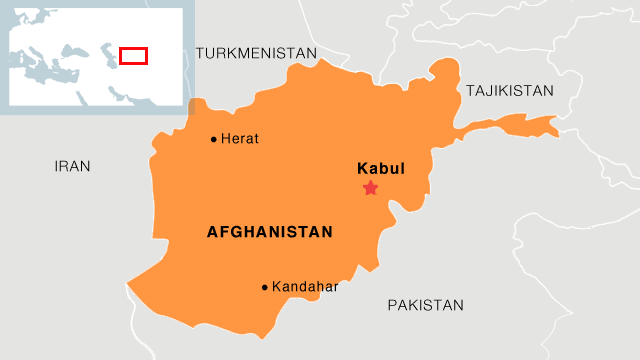
The matter of legitimacy in Pakistan is a sensitive subject and perhaps that is one of the reasons that I've never really been drawn into a protracted discussion on the Durand Line. However, in the same way I see India as a broader historical entity than a supposed 'Hindu' country that begins in 1947 at the Wagah Border, I think it is natural to consider my identity as a Pashtun in the broader sense; that is Afghanistan as a natural homeland and in the historic and etymological sense, Pashtun = Afghan.

It is this view of historical identity that is a sensitivity in Pakistan and is key in shaping its foreign policy. In Pakistan, the simplified version in their school textbooks is that they were carved out of British Indian territory in 1947 as a Muslim homeland. However, that would be the story for less than half of modern Pakistan, as Pakistan did not comprise Indian territory alone. Afghan territory (the Frontier/North West Frontier) under the Durand Agreement of 1893 ceded to British India was also included in Pakistan in 1947. The Durand agreement between Moritmer Durand and the Amir Abdur Rahman Khan remains heavily disputed - the claim being that it was 'forced' under duress.  

To date, the Durand Line which bisects the historic Pashtun lands remains toxic to security and economic advancement in the region. Afghanistan has never recognised it as an international boundary. Pakistan's Afghan policy, on the other other hand, has been shaped by military generals who have attempted to distract regional nationalism amongst the Pashtun and Baloch  by backing militant groups; even when this runs counter to their own domestic security. That said, despite Islamabad's bankrolling of the Afghan Taliban, the Durrand Line was not ratified as an international border during the Taliban's watch in the 1990s. This however, hasn't appeared to have changed Pakistan's policy pursuit - international commentators note that Islamabad is ready to tolerate the domestic Taliban in order to keep alive its strategic depth policy in the aftermath of NATO's withdrawal.

Afghan foreign policy still views Pakistan as artificial construct that will one day dissolve in the face of the multiple conflicts within its society. A similar point was echoed to me last year in Kabul when I met with senior members of the Afghan administration.


The disputes in the region remain territorial based on past histories. There is another aspect - one of identity which ultimately many fall back into - that cannot be ignored. One day NATO will have to go. And so it should. However, consider this comment from the LA Times:

A plausible scenario upon the large-scale departure of international troops in 2014 is either disintegration into civil conflict or a de facto division of power along ethnic lines, with a Pakistan-backed Pashtun bloc in the south and east lining up against one or more northern non-Pashtun blocs that might well gain military support from India and Uzbekistan, if not Iran. Recent signs indicate that many key players are already rushing to consolidate their positions within this framework, already operating, for all intents and purposes, in a post-2014 world.
 

Sunday, 21 October 2012

ملالې تا خو لر او بر وژړو

Dedicated to Malala Yousafzai 


ملالې تا خو لر او بر وژړو
هم دې شمساد هم
دې خیبر وژړو
یه د هلک په وار پیدا ملالې
نن د افغان هر ټبر دې وژړو
د پښتونخوا هر بوټی ګل خپه دی
تا خو د ګرد وطن هر غر وژړو
ستا د قلم زوره نن خبر شو
د تور تمیانو دی لښکر وژړو
مئندې زامن نه، لوڼې غواړي
نجوني خو ژاړي تا هر نر وژړو
کاش د ضیا په ځای کي زما لورکئ وی
د وطنپال خو د
ې ځیګر وژړو

http://www.facebook.com/watan.pal

Friday, 19 October 2012

The Tragedy of Malala


In this climate of agendas, I admit to some confusion about what I am being told and it is never always absolutely clear what is the truth; and what is blatant propaganda. Over the years, and particularly since I began this blog I have been offered many loose ends and have read way too many conflicting accounts to be sure all the time. This makes the events surrounding Malala Yousafzai's shooting all the more tragic. Primarily I pray for her speedy recovery and condemn the bigotry that led to her shooting. May Allah bring peace and justice to all those caught up in the ongoing war and the acts of terror in the Pakistan-Afghanistan belt. May people be afforded the right to go about their business according to their faith and conciousness free from the threat coercion or attack. Ameen. 

Part of me cannot escape noticing the ring of political and media exploitation surrounding Malala's life, or even the fact that the girls who were shot with her, Kainaat and Shazia, are all but forgotten. There is no doubt that these are remarkable individuals and I keep them all in my prayers. Out of the tragedy, I wish to see these girls strong in their resolve - to acquire the education that has been the cause of the controversy in Swat and to be part of that change that will allow them as Pashtun women to be the social equals that men and women in Bacha Khan's vision were meant to be.

This is an important parallel. Bacha Khan recognised the crucial need for education amongst the Pashtuns - for both men and women and Malala would embody that. She bravely stood up to intimidation when girls' schooling was banned in Swat and in doing so adopted a very political position. I offer this with a little caution however. To be political is one thing; to be caught up in someone else's politics is something else. Since the fall of the Taliban in Swat, Malala has been courted by the Pakistani and the world media with their varying views  - all wishing to push their own messages through her.

Note this quote from BBC World TV documentary about her made two years ago. She is twelve years old at the time.
Malala: “I want to ba a doctor but my father told me you have to be a politician. But I don’t like politics.”
Father: “My daughter can be better than a doctor.”
Malala's desire for an education was genuine and highly commendable; but she was thrust into the firing line by an ambitious father and an ambitious documentary maker apparently unconcerned by her direct statement that she was being manipulated against her will.

Having been shot, Malala has now been airlifted and is receiving world class treatment in Birmingham, England. I hope that she recovers and in the long term goes on to a happy and fulfilled life as a doctor. For most children caught in the 'War on Terror', however, the story is very different. The truth is that Malala is not getting this treatment because that is what is done for children attacked in Afghanistan and Pakistan. She is getting this treatment because she became, and remains, an exploited propaganda symbol. If people really cared about Pashtun children, Malala would not be a public figure in the way that she now is. Pashtun children would not have to 'fight' for their right to education and nor would they be filmed fighting for their lives in hospitals.  

Read this view for more thoughts on this story. 

Related Posts Plugin for WordPress, Blogger...